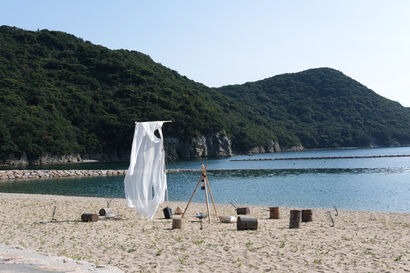
Clouds never hold a single shape. They drift with the wind, break apart, overlap, disappear, and appear again. I have always sensed in them a freedom that seems bound by nothing, and the immensity of nature beyond human understanding or control. This work began with a desire to create a space where one could feel the air and wind with one's whole body, as though immersed in a cloud.
On the shore of an uninhabited island in the Seto Inland Sea, Japan, I erected wooden posts, stretched translucent fabric between them, and placed a light at the center. Caught by the wind, the fabric swayed, billowed, sagged, and overlapped. Its contours shifted constantly, blurring the boundary between inside and outside. People who gathered there talked, fell silent, and sometimes fell asleep with the fabric draped around them. The work was never complete in its predetermined structure alone. It continued to change with the passage of time, the forces of nature, and the people who entered it.
Visitors were given no instructions on how to spend their time in the space. Yet as night fell, they found their way there naturally, sitting, lying down, talking, and spending time together. One participant called it a "room." Though the wind passed freely through it and its boundaries were never fixed, the space held, for someone, the intimacy of a place to return to. That word was an unexpected discovery for the artist as well.
Just as clouds take shape through their constant interaction with the surrounding environment, this space, too, assumed different forms through the interplay of its many elements. What the artist constructs is not the events themselves, but the conditions in which something might occur. Rather than determining in advance what will emerge, the work leaves open the possibility of change through encounters with the environment and with others. The time people spent together on the shore at night, and what they felt and experienced there, was one such event that emerged from this openness.