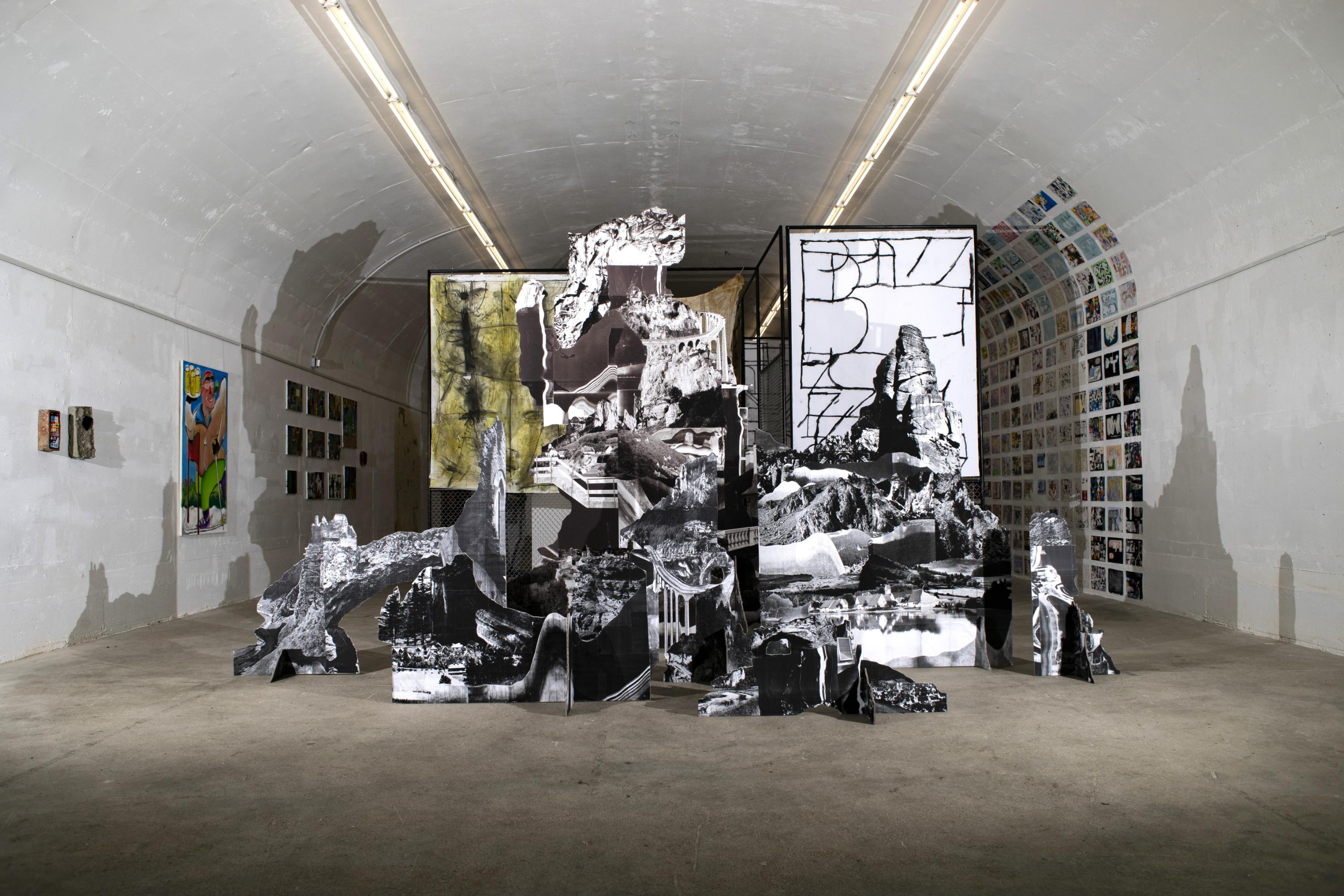
Berg- und Talfahrt is a large-scale spatial collage that unfolds between landscape, architecture, and model. Made of corrugated cardboard, photographic fragments, and layered constructions, it creates a fragile topography reminiscent of mountains, ruins, or provisional structures. The space itself becomes the carrier of the image – instability and transformation are not only its subject but also physically present.
The work investigates how reality reveals itself in fragments. Here, landscape is not a fixed depiction but a process: layering, rupture, and displacement form a structure that is always in flux. What emerges is an open system of transitions – a collage that resists any claim to final form.
In the context of our present moment, this fragility takes on urgent relevance. Berg- und Talfahrt is not only a topographic motif but also a metaphor for our time: a succession of crises, disruptions, and provisional balances. Political and ecological upheavals, technological acceleration, and social compression all resonate within the unstable architecture of the work. It refuses easy answers and instead reveals the oscillation between ascent and collapse, between hope and disintegration.
At the same time, the installation points to its own materiality. Corrugated cardboard – an everyday, recyclable material – stands for transport, logistics, and global circulation. Within the exhibition space, this economy of packaging is transformed into a poetic landscape. The revaluation of the material mirrors the artistic strategy itself: to create from the marginal and ephemeral something that appears monumental – and yet could fall apart at any moment.
Berg- und Talfahrt functions as a figure of thought: a fragile architecture that does not suppress instability but makes it visible. It invites us to live with uncertainty, to acknowledge change as a condition of reality, and to search for new perspectives in the fractures.
As a spatial collage, the work also recalls the avant-gardes of the 20th century, who used fragment and montage to articulate the ruptures of their time. Today, in the “new twenties,” this method feels more relevant than ever: collage is not a style but a tool to grasp complexity, to embrace ambivalence, and to test possible futures.
Thus Berg- und Talfahrt becomes more than an installation: it is a metaphor for life in permanent transition – a space that invites viewers to move through a landscape of fragility, where past, present, and future are in constant reconfiguration.