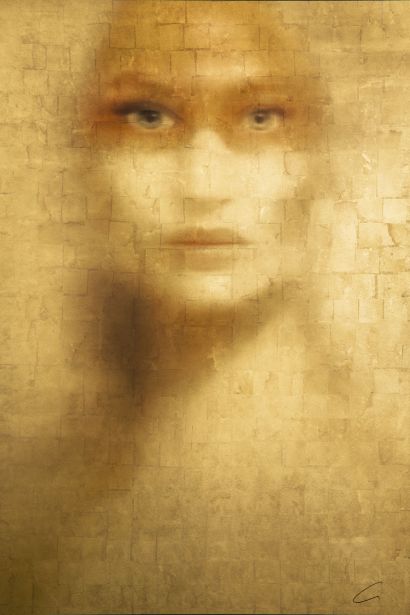
Prudentia – Wisdom
Prudentia is not knowledge.
It is the pause before knowledge.
It holds the ability not to act immediately, not to judge too quickly—but to see.
A quiet perception of the world that reaches beyond the obvious.
The face appears and withdraws at the same time, as if resisting immediate definition.
It is not fixed, not fully formed, but permeable—a state between perception and understanding.
Prudentia is the capacity not only to recognize things, but to grasp their connections.
Past, present, and possibility exist within it simultaneously.
It is the silent instance within us that questions before it answers.
That hesitates in order to become clear.
That does not illuminate by force, but by order.
In this work, wisdom does not appear as strength, but as stillness.
Not as possession, but as process.
Prudentia is a light that does not shine—
but reveals.
Prudentia is part of the series "Seven Virtues"
The Seven Virtues are more than a moral concept.
They are an inner coordinate system of human existence.
Since antiquity, they have formed the foundation of ethical thought. In the works of Plato and Aristotle, the four cardinal virtues—prudence, justice, fortitude, and temperance—appear as expressions of a life in balance. They do not describe rules, but attitudes: a conscious relationship to the world and to oneself.
Later, Christianity expanded them with the three theological virtues—faith, hope, and love. With them, the focus shifts: from human action toward inner trust, longing, and the capacity for connection.
Yet beyond any religious or cultural classification, the virtues reveal something universal:
They do not belong to a specific time, religion, or origin.
They are inherent in the human being.
This cycle translates this idea into a visual language.
Each virtue appears as a face—fragmented, permeable, embedded within a golden surface. The choice of different ethnicities makes visible what has always been true:
The virtues are not a cultural construct—they are a shared inner origin.
The gold does not refer to material value, but to something else:
to what endures.
To what exists beneath all external layers.
The faces seem to dissolve and emerge at the same time.
They are not fixed, not complete.
They are states.
A field of tension arises—between individuality and universality, between body and idea, between visibility and dissolution.
The Seven Virtues are not explained here—
they are made perceptible.