Between summit and abyss, between the untouched whiteness of childhood snow and the worn stone of an artificial present, a hiatus opens. A brutal rupture in time. A silence that is not peace, but a tear: where there was snow, now only dust. Where there was descent, now disfigurement. This photographic work is inscribed in that fracture—not only as denunciation, but also as mourning. A visual elegy to the body of the mountain, to its wounded memory, its slow erosion, and the certainty of its finitude.
The motivation arises from the depths of Filippo Poli’s family archive and from a desire to document the injured anatomy of the Alps, intertwining his intimate biography with the devastated geography of place. The author returns with his son to where it all began—Valle d’Aosta, Cervinia, 1983—but the landscape no longer responds. The mountain that shaped his imagination is gone. Only fragments remain: remnants, fossil structures of a broken promise. Where past generations learned to ski, others will have nowhere to fall. As an architect, Poli sees in this transformation not just a cultural space: the relationship between inherited landscape and the forms that have deformed it cuts through him, encoding a personal loss.
The images in this project inhabit multiple layers of time. There is a past revealed in black-and-white negatives: childhood, ritual gestures, the mountain range as refuge and narrative. When gliding down the slope and tracing a path was almost a spiritual act. Snow was not just matter—it was promise, root, belonging. That snow-covered terrain, intimate and welcoming, seemed suspended in luminous eternity. The framing of each photograph matters: every image from the family album is a room that holds a way of being, of seeing, of caring.
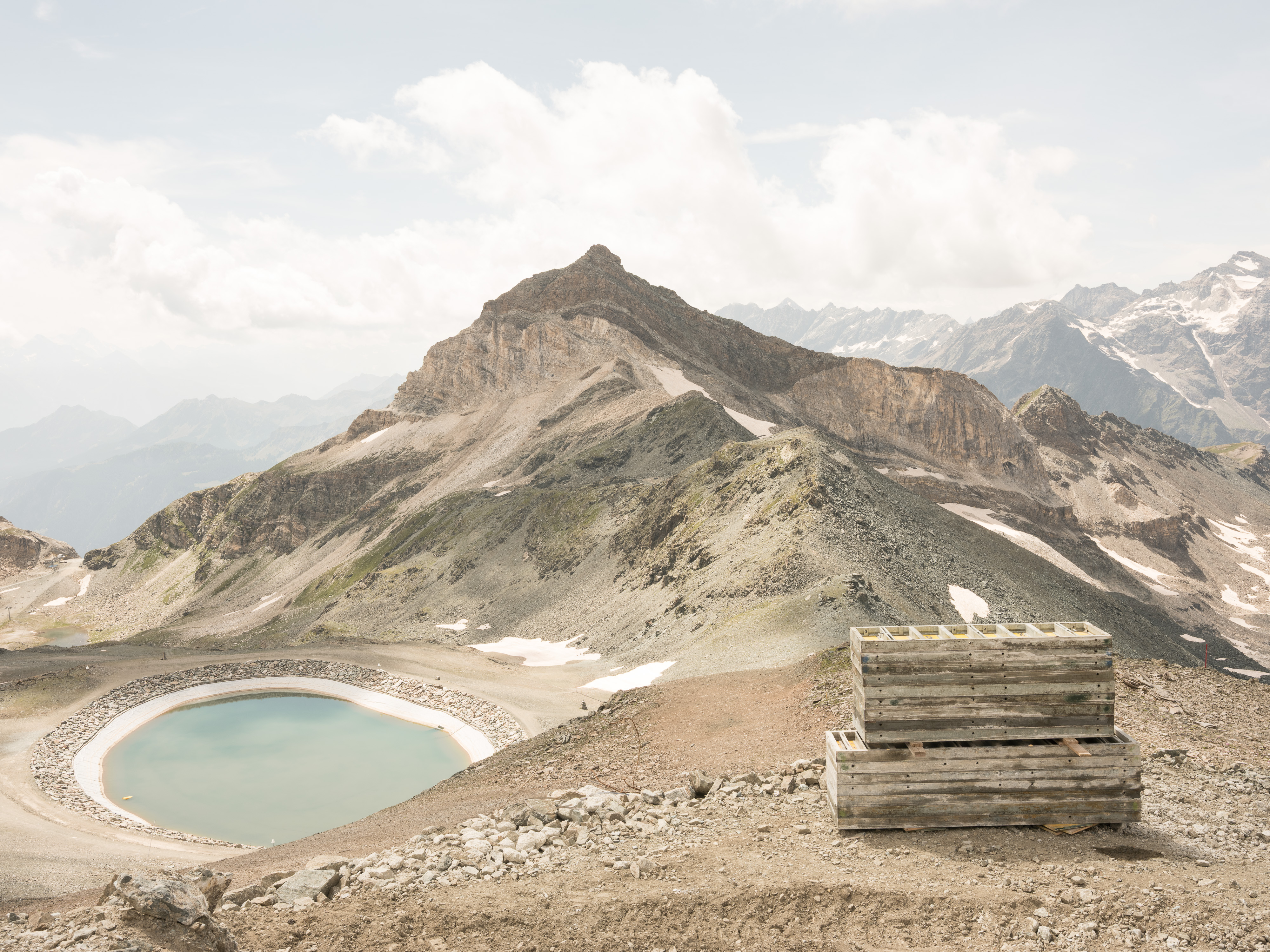
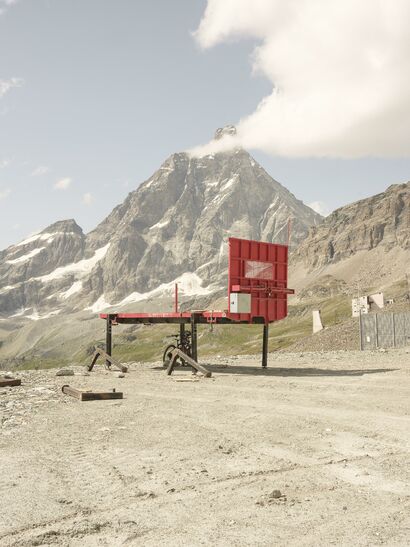
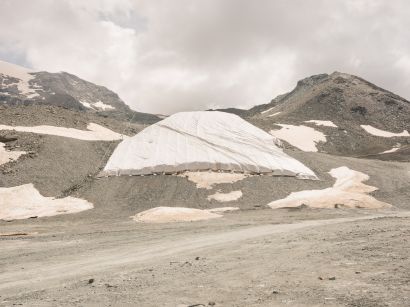
The present, by contrast, bursts in with color—but it is wounded. The gesture now is technical, repetitive, forced. An artificial dam deforms the slope, holding back what once fell freely. The ski season is no longer lived—it is simulated. The views have become a desert of concrete masses, coiled hoses, and metal piping. Where once there was ritual, now there is machinery.
Yet the family album and the contemporary gaze do not form a linear narrative. They do not look at each other with tenderness—they confront one another. What is exposed is not mere transformation, but a loss of meaning. Those peaks that once drew a solid horizon are now symptoms of fragility. A warning sign. And the data confirms the wound: in Italy, as of today, 265 ski facilities lie abandoned. In the 2021–2022 season, 90% of slopes relied on artificial snow. Covering just one hectare requires a million liters of water—the equivalent of 10,000 people’s consumption. Circular reservoirs—165 projected in Italy by 2025—are built to sustain an illusion that lasts only a few months. These are not lakes: they are open scars on the land. Not solutions, but surgical interventions on an already exhausted body.
The toponym “Alps” may derive from albus, white, or alp, stone. At that semantic crossroads lies the heart of Alpine Hiatus: between the whiteness that once cloaked the surface and the hardness that emerges when the veil dissolves. The sublime splendor embraced by those who came before has given way to a shadow of suspicion and unease. What once seemed immortal now reveals its fragility: glaciers retreat, snow fails to arrive, machines fabricate winter where no transitions remain.
And yet, the possibility of looking endures—even if marked by the trauma of a wounded and domesticated natural world. To remember becomes a complex, tense act, charged with nostalgia and irreparable loss. These photographs do not seek comfort, but to awaken an uneasy awareness. They do not romanticize an idealized past, but interrogate it from a hostile present. What is at stake goes beyond ecological crisis—it is an ethical question. How do we love a land that is being destroyed in the name of progress? How do we pass on a legacy when the landscape that shaped our identity no longer exists—or has become uninhabitable?
Alpine Hiatus is an attempt at an answer. Not a closure, but an open fissure. A gesture of attention to what is crumbling. A form of mourning that becomes poetic resistance: because even if snow no longer tastes like snow, it is still possible to look. Still possible to remember. This project clings to that possibility. And in that gesture—small but resolute—snow becomes word.
It becomes act. It becomes permanence. Still, perhaps, there is time.
© Mireia A. Puigventós