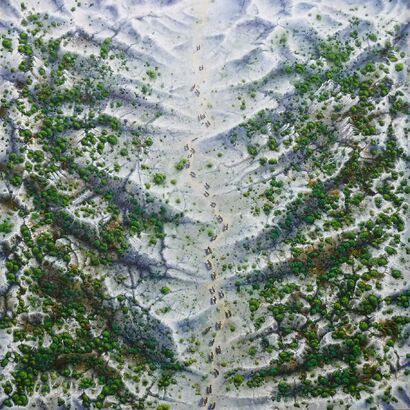
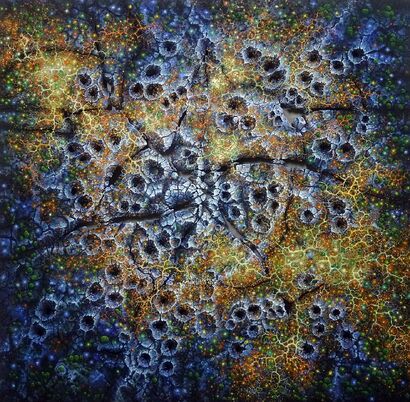
He
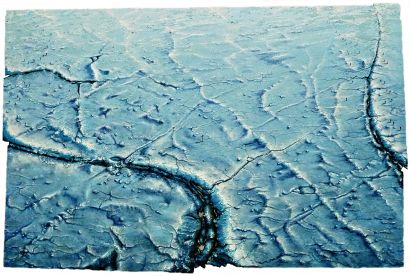
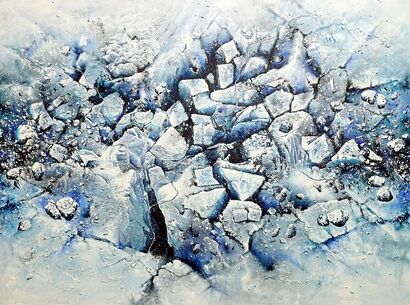
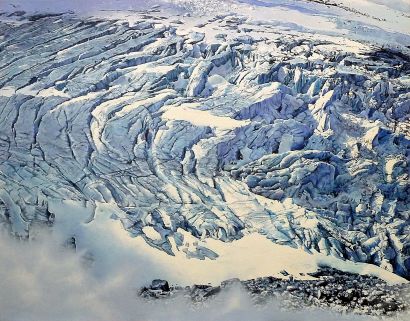
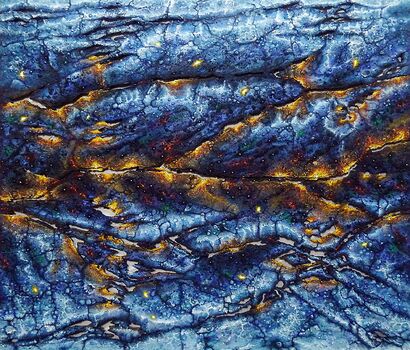
utilizado pigmentos, aglutinantes, serrín, arena de mármol, pan de
oro y acrílico. Realizado
sobre soporte de madera fragmentado en pedazos que he vuelto a unir
dejando en el proceso agujeros y grietas.
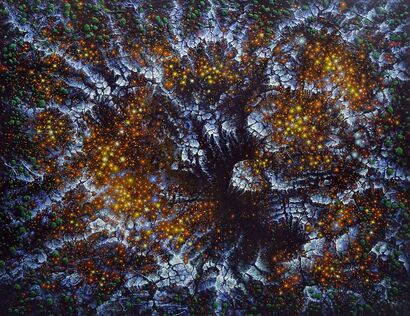
En
mis obras más recientes, la materia, la luz y la forma emergen de
fondos casi negros y opacos. Pinto sobre paneles de madera
fragmentados que nuevamente vuelvo a restaurar, dejando grietas,
huecos y agujeros visibles en la pieza final. Estos vacíos se hacen
más grandes y dominantes en cada nueva obra, a veces ocupando más
espacio que la propia pintura. Estos "vacíos" existen solo
en virtud de lo que los rodea —la materia pintada—, pero no
llevan la huella directa de mi mano. Esa es la paradoja: pintar para
dar espacio y significado al vacío.
Existe una profunda
resonancia entre la ciencia y el misticismo oriental, particularmente
en el budismo. Ambos llegan, mediante métodos muy diferentes, a
conclusiones sorprendentemente similares sobre la naturaleza de la
realidad. La ciencia nos dice que la forma y el vacío son dos
aspectos de la misma realidad, que coexisten e interactúan
continuamente. El budismo lo expresa con la frase: «La forma es
vacío, y el vacío es forma».
Hay una entidad fundamental
(conciencia) que la teoría cuántica de campos, e incluso el propio
Einstein, describieron como la base de todas las cosas. El campo
cuántico puede verse como un océano invisible de energía que
conecta todo en el universo. Dentro de este campo, cada pensamiento,
emoción y partícula está interconectado, afectado por y afectando
a todo lo demás.
----------------------------------------------------------------------------------------------
I
used pigments, binders, sawdust, marble sand, gold leaf, and acrylic.
The work was done on a wooden support, broken into pieces, which I
reattached, leaving holes and cracks in the process.
In
my most recent works, matter, light, and form emerge from almost
black and opaque backgrounds. I paint on fragmented wood panels,
which I then restore, leaving cracks, gaps, and holes visible in the
final piece. These voids become larger and more dominant in each new
work, sometimes occupying more space than the painting itself. These
"voids" exist only by virtue of what surrounds them—the
painted material—but they bear no direct imprint of my hand. That
is the paradox: painting to give space and meaning to the void.
There
is a profound resonance between science and Eastern mysticism,
particularly Buddhism. Both arrive, through very different methods,
at surprisingly similar conclusions about the nature of reality.
Science tells us that form and emptiness are two aspects of the same
reality, continually coexisting and interacting. Buddhism expresses
this with the phrase: "Form is emptiness, and emptiness is
form."
There
is a fundamental entity (consciousness) that quantum field theory,
and even Einstein himself, described as the basis of all things. The
quantum field can be seen as an invisible ocean of energy that
connects everything in the universe. Within this field, every
thought, emotion, and particle is interconnected, affected by, and
impacting everything else.