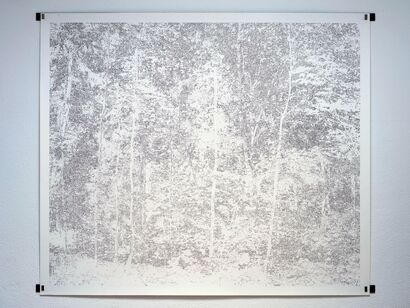
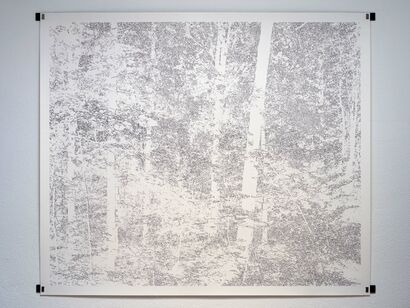
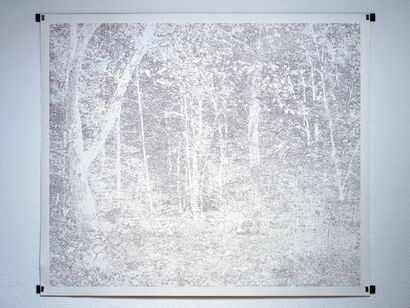
The truth of the story lies in the details. – Paul Auster, “The Brooklyn Follies“
This work is a contemporary reinterpretation of
two distinct yet complementary art historical lineages. It transforms
Botticelli’s symbolic natural order and Hōitsu’s poetic sense of seasonal
change into a silent visual field where detail and overall harmony coexist. The
more one observes, the more one is drawn into the intricacies – and yet, a profound
calmness prevails. A quiet, intelligent masterpiece.
Composition and Wholeness – Botticelli's Influence
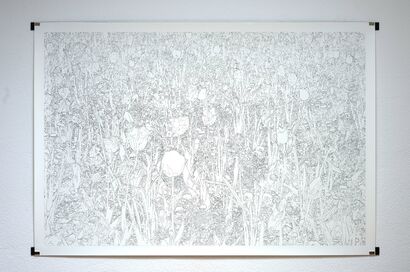
The surface is densely filled with detailed
renderings of flowers, leaves, and stems, with no single focal point. This
compositional approach echoes Botticelli’s Primavera, in which the figures are rhythmically arranged, and
nature appears ordered with intellectual clarity. Here, too, the plants seem to
dance to an invisible rhythm, suggesting a choreographed harmony within natural
chaos.
Line and Space – Sakai Hōitsu's
Influence
What stands out is the delicate, continuous
linework. This recalls Sakai Hōitsu’s screens such as the Summer and Autumn
Grasses, which emphasize atmosphere through restrained brushwork. However,
unlike Hōitsu's generous use of empty space, this artist adopts a reverse
approach: by filling every part of the surface, a paradoxical "emptiness
through abundance" emerges. The consistent density and lack of tonal
contrast prevent the eye from settling, creating an endless spatial expansion –
a visual characteristic of the Rinpa school.
Symbolic Layer – A Fusion of Traditions
Just as Botticelli’s Primavera is rich in
allegorical meaning, this drawing evokes symbolic associations. Each plant is
given equal attention, evoking a timeless "garden" or "eternal
spring." In this way, Botticelli’s idealized mythological vision of nature
merges with Hōitsu’s seasonal poetry and sensitivity.
Technical Points of Interest
– The Aesthetics
of Line: By using only line and omitting color, the artist invites the viewer
to mentally reconstruct the hues – a meditative,
imaginative process.
– Visual Density vs. Silence: Despite the intricate detail, the work
feels serene and contemplative. This reflects the merging of Botticelli’s
intellectual order and Hōitsu’s atmospheric stillness.
* Sakai Hōitsu[a] (August 1, 1761 – January
4, 1829) was a Japanese painter of the Rinpa school.[2] He is known for having revived
the style and popularity of Ogata Kōrin, and for having created a number of
reproductions of Kōrin's work.