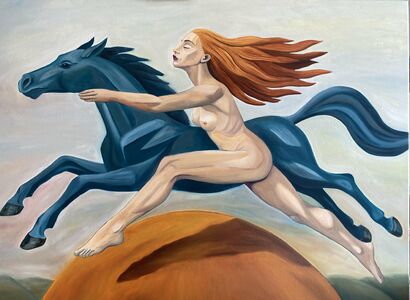
Ontological Rupture inaugurates the Beyond the Human cycle, a reflection on the transformations of human identity in the age of intelligent technologies.
Particular attention is given to the human figure: facial expressions, gestures, and postures are progressively refined to convey presence, emotion, and agency. This human vitality is set against the mechanical forms of the machine that humanity itself has created, generating a visual and conceptual tension between creator and creation. Like a contemporary echo of Mary Shelley’s Frankenstein, the work examines the ethical and existential implications of technological innovation, exploring the increasingly fragile boundary between life and artifice, consciousness and simulation.
Through successive layers of oil paint, later refined with Liquin glazes that enhance luminosity and depth, Humm constructs a unified and compelling pictorial surface. The polished quality of the image is not merely a formal choice; it becomes an integral part of the work’s meaning—a space in which human and machine coexist in a state of attraction, conflict, and mutual transformation.
The painting forms part of the broader Beyond the Human project, conceived by Philipp Humm as a true Gesamtkunstwerk—a total work of art that brings together visual art, film, literature, and theatre. Through paintings, films, essays, a novel, and a stage play, the project explores, from complementary perspectives, the philosophical, ethical, and cultural challenges posed by the rise of artificial intelligence and new forms of coexistence between humans and machines.
Ontological Rupture ultimately invites viewers to reflect on one of the defining questions of our time: how can we preserve what we understand as human in a world increasingly shared with the technologies we have created?