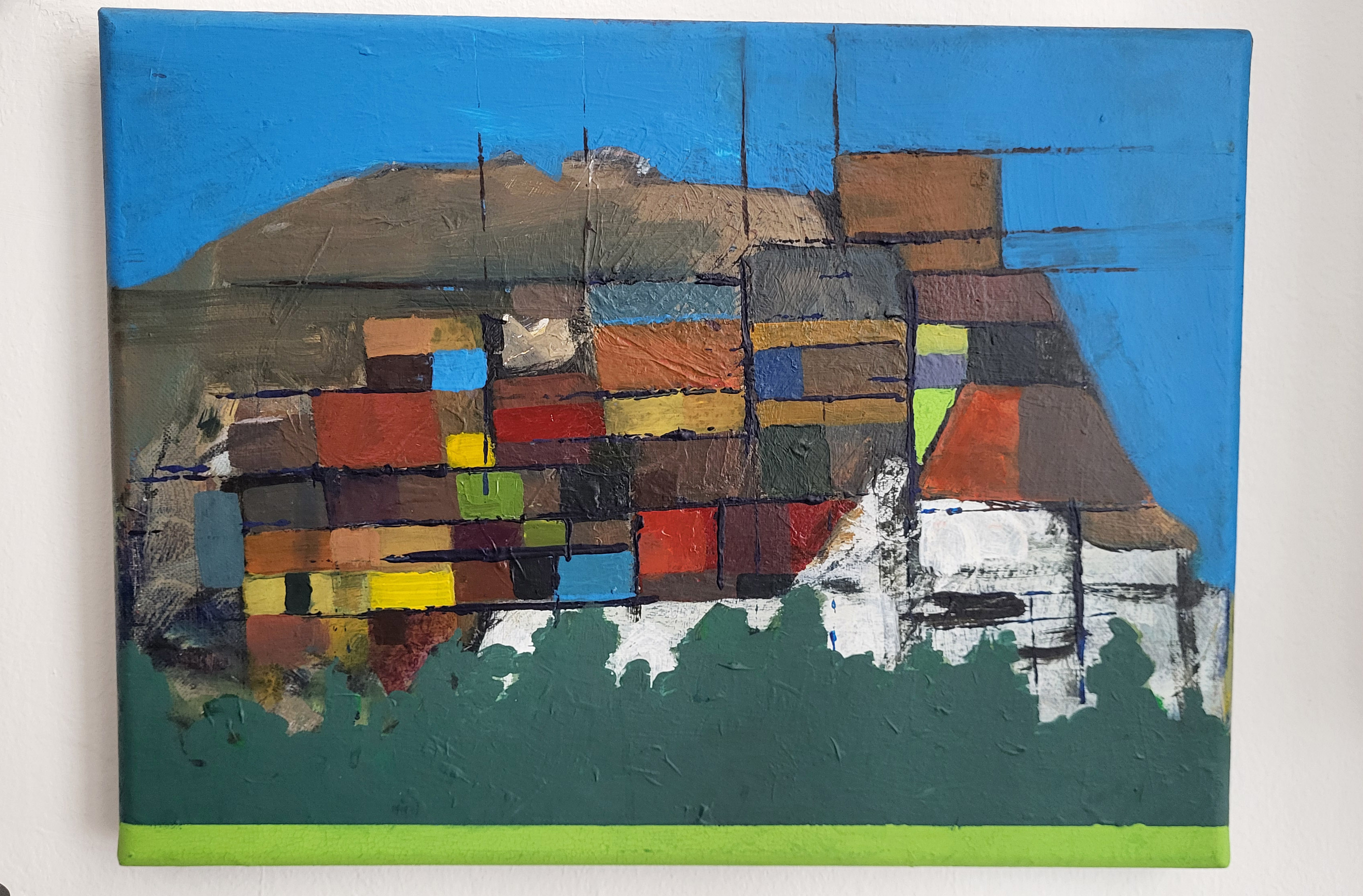
This work reinterprets a coastal landscape through a system of geometric fragmentation. The recognizable silhouette of a hill or fortified landmass is overlaid with a grid of colored rectangular units, suggesting an urban fabric emerging within or imposed upon the natural environment. The composition negotiates the boundary between landscape and constructed space, where architecture becomes inseparable from terrain.
The layered application of paint—alternating between textured, almost eroded surfaces and flat, saturated color fields—evokes the accumulation of time, memory, and human intervention. The grid operates not as a rigid structure but as a flexible framework, allowing irregularities, overlaps, and interruptions. This reflects the organic way cities evolve, shaped by both planning and contingency.
The bright chromatic accents embedded within more muted, earthy tones function as visual disruptions, hinting at moments of activity, habitation, or encoded information within the landscape. The foreground, simplified into a dense green mass, creates a visual threshold, reinforcing the idea of distance and observation.
Ultimately, the work explores how place is constructed—not only physically, but also perceptually—through layers of memory, structure, and abstraction.