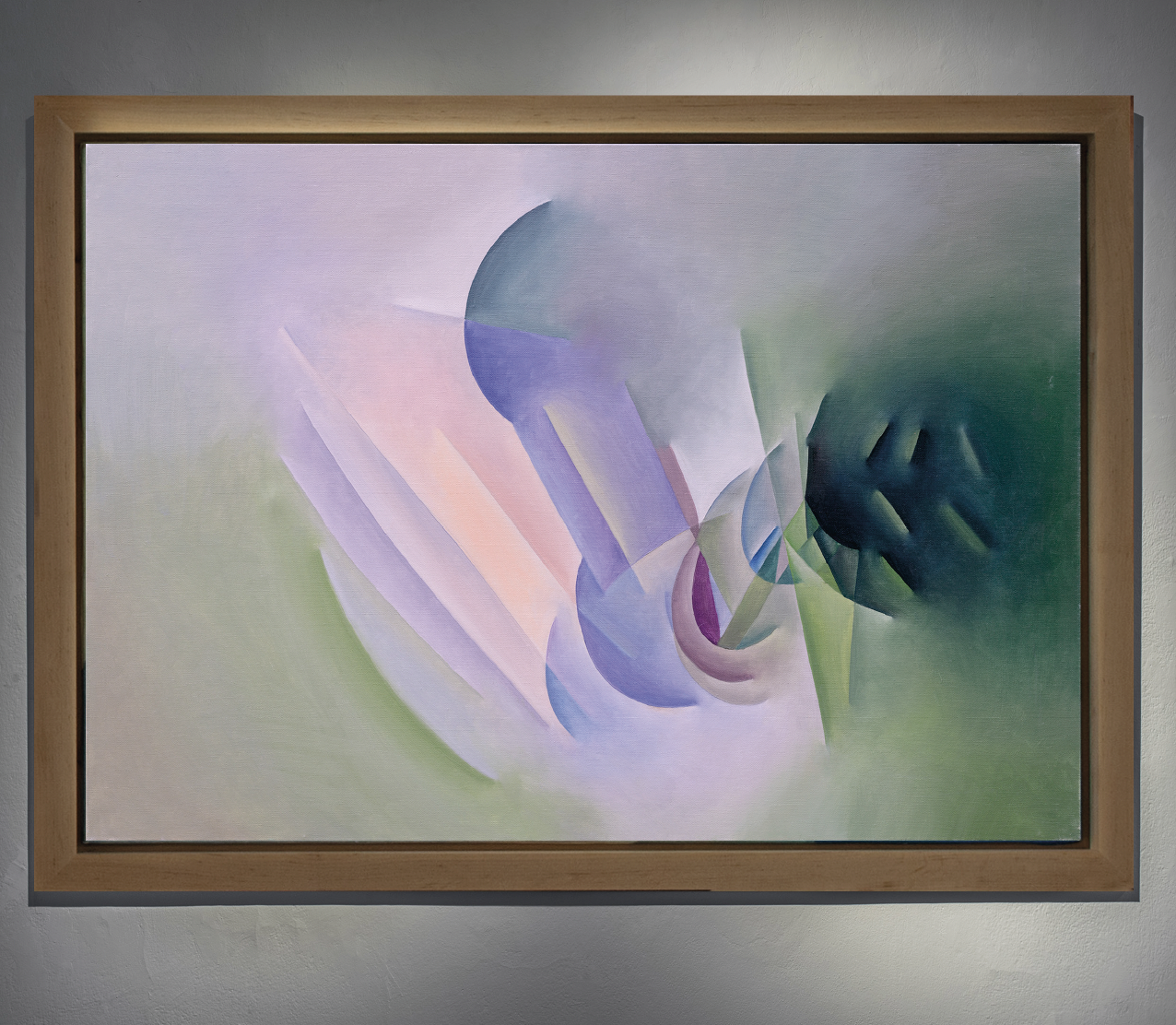
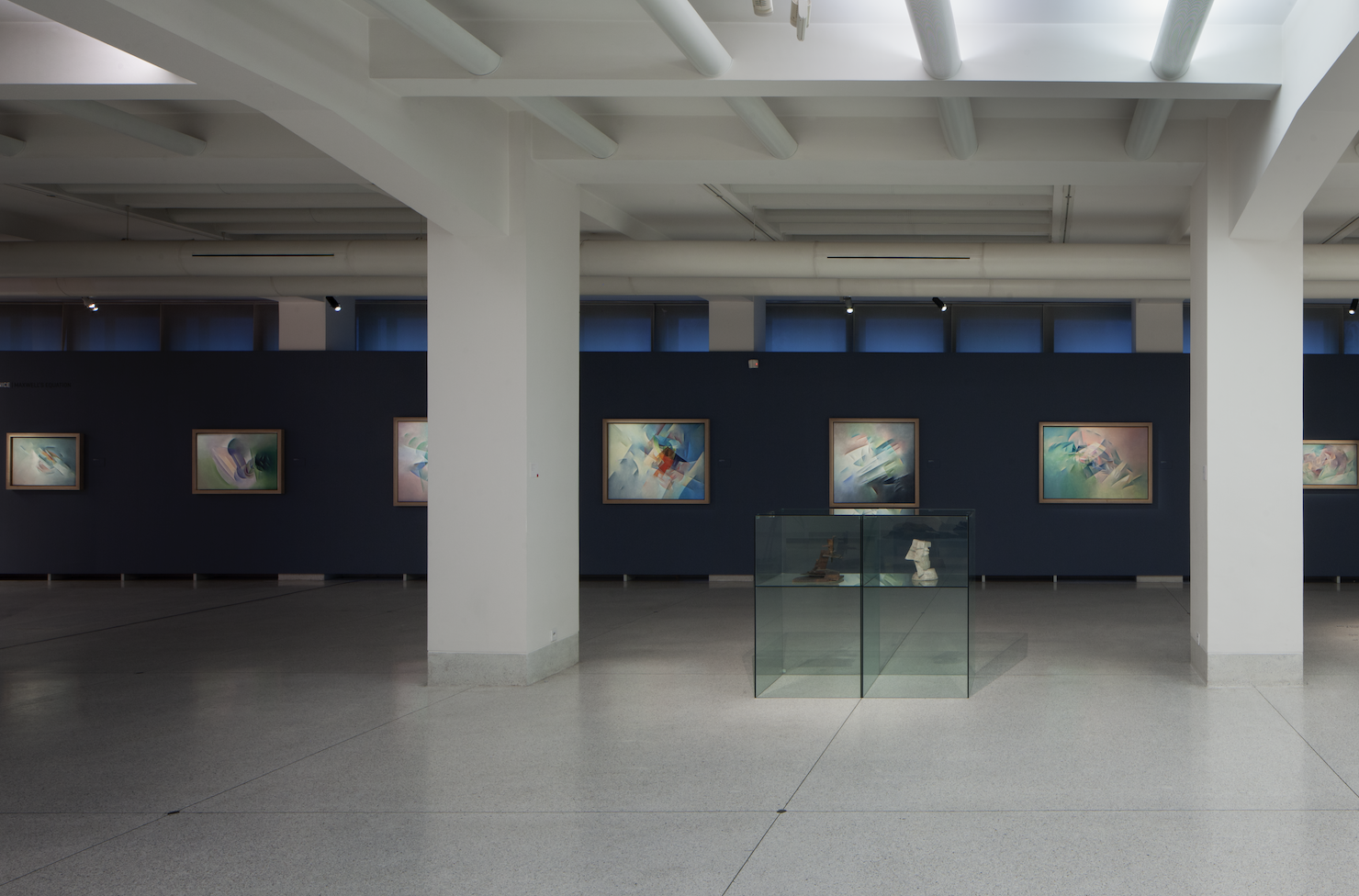
Lucie Svobodova's oil paintings were exhibited at the National Gallery in Prague as an intervention in the permanent exhibition Czech Modernism. Originally, it was a confrontation of paintings from the 1930s, created intuitively or with the use of geometric order, with the artist's contemporary paintings, which are created through a dialogue between the artist and a computer program. Svobodova uses the computer as a tool for generating visual impulses, which then become the basis for her paintings. The artist uses the principles of gradients, which are important for understanding light and colour in Maxwell's equations, and applies them to the creation of paintings using modern technology. In order to visually observe the results of individual brushstrokes, the resulting gradient field needs to be converted back to absolute (scalar) values to get instant feedback. Only the latest technologies make it possible to use the response calculation as the basis for image formation. Svobodova uses computer and digital image processing in a previously unexplored area to create a "painting in the gradient field".
Overall, Lucie Svobodova's "Maxwell's Equation" is a work of art that takes inspiration from physical theory while demonstrating the possibilities of modern technology in the visual arts.
As the Czech philosopher Prof. Miroslav Petříček wrote about these works, "The canvas is a virtual field and the virtual field is the canvas."