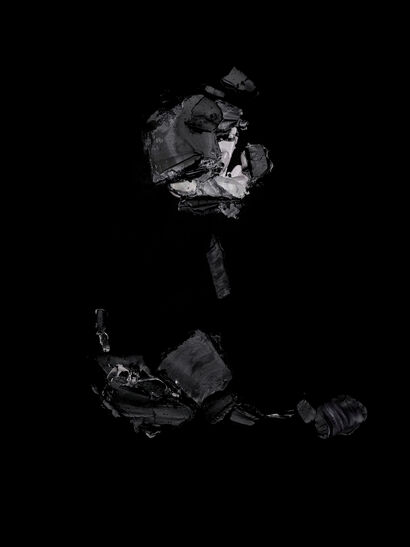
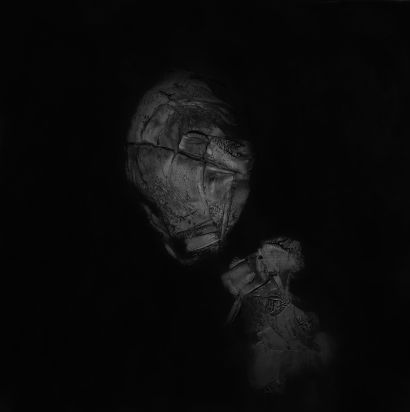
The black duckling emerges as a figure of continuous transformation in a world where stability is no longer a fixed condition. Its image captures an ongoing process of change in which form is not destroyed or replaced by another, but gradually restructured from within while remaining within the boundaries of its own existence.
Transformation here is understood as a fundamental mode of contemporary experience — a way of existing within a shifting environment where identity has no final version and is constantly reassembled under the influence of both external and internal factors.
Strength of spirit is expressed not as resistance to change, but as the capacity to continue developing within this process, maintaining an inner direction even in the absence of stable forms.
The duckling becomes an image of a living process of transformation — a fragile yet steadily evolving organism in which vulnerability and adaptation coexist simultaneously. It exists as both witness and participant in this condition, where change is not an event but a continuous structure of being.