The title draws its potency from history. “Emerald Green” was the celebrated pigment of the 19th century—known also as Paris or Schweinfurt Green—a symbol of opulent progress that was, in truth, a killer in disguise. Composed of arsenic, it offered dazzling beauty. Here, becomes a metaphor for our contemporary compacts: the seductive, "clean" promises of innovation that carry an invisible, corrosive cost.
The painting stages an encounter with this duality. The left figure presented is not a mythological devil, but a contemporary manifestation—a projection of our own temptations and the sleek embodiment of a corrupted system, the very machinery of power. Its offerings—framed as pure progress—artfully mask layers of exploitation, datafication, and control.
Thus, the right human form is caught in a silent fusion. Seduced by visions of wealth, comfort, and advancement, it becomes increasingly integrated with the machine—connected, dependent, and subtly enslaved. This control is not seized, but willingly granted.
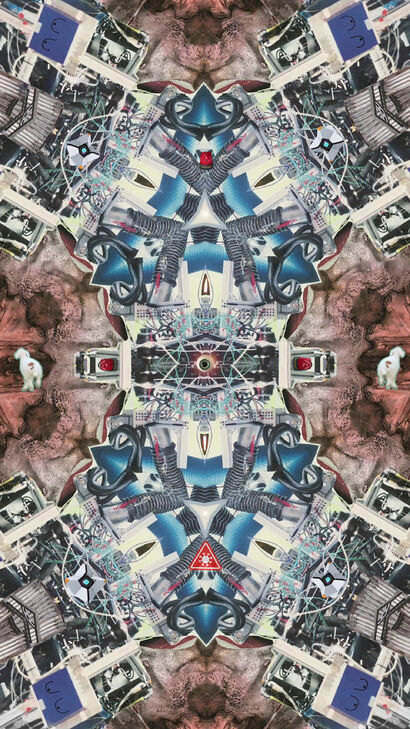
The space itself is a constructed reality: a matrix of mirrored reflections suggesting a multi-narrative of forking paths and parallel outcomes. It prompts a haunting question: do we truly choose, or do we merely navigate within systems already designed for our assent?
Agreement in Emerald is a chapter in the ongoing Multiverse series of works, created through a collage-based painting process. Fragments of open-access digital imagery are disassembled and reborn on the canvas, mirroring the construction of contemporary identity—a layered, fractured palimpsest, endlessly rewritten.
This work dwells consciously in the liminal space between attraction and consequence, desire and submission, autonomy and comfort. It proposes that the most binding agreements of our age are often silent, enacted not through force, but through seduction, leaving us to wonder what, in our thirst for the emerald future, we have already consented to lose.