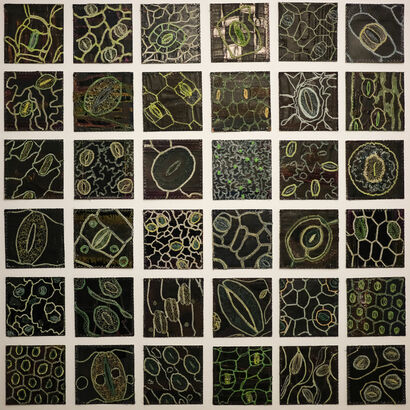
Gabriele Schuller was born in Wels, Austria, and currently lives in Linz, while working mobility across various locations in Europe. After training in textile technology at the Höhere Bundeslehranstalt für Textiltechnik in Vienna, she studied graphic design (New Design Centre,...
Read MoreGabriele Schuller was born in Wels, Austria, and currently lives in Linz, while working mobility across various locations in Europe. After training in textile technology at the Höhere Bundeslehranstalt für Textiltechnik in Vienna, she studied graphic design (New Design Centre, St. Pölten), sculpture and figure drawing at Kunstschule in Vienna, and completed internships in carpet restoration and hand weaving. Her artistic development was further enriched by studies in cultural mediation at the Private Pedagogical University of the Diocese of Linz.
Her artistic practice connects material, landscape, memory, and social structures. Textile processes such as crocheting, weaving, spinning, and sewing serve as her artistic language to explore and make tangible personal history, social relations, and the relationship between humans and the environment.
In addition to her artistic work, she has been active in art education for many years, including at the European Patent Office in Munich (2004–2020), at the Bundesgymnasium Vöcklabruck, and at the Austro-Hungarian European School in Budapest. She has also undertaken curatorial work, most recently for the project Drawing a Thread as part of the European Capital of Culture Salzkammergut 2024.
Residencies have taken her to the guest studio of the Oberösterreich Art Collection (Bad Hall, 2023), the Nähe und Distanz symposium at the Leonding City Museum (2022), and the guest studio of the University of the Arts Bremen in Vallauris, France (2001).
Her work has been exhibited across Europe, including in Austria, Germany, Spain, Poland, and Slovakia. Recent exhibitions include Transformations (Textilfest Igualada, 2025), De:growth (20ger Haus Ried, 2025), and Gott und Geld (Stift Klosterneuburg, 2025). In 2025, she was nominated for the St. Leopold Peace Prize for humanitarian engagement in the arts.
Her artistic approach operates at the intersection of memory culture, care work, and ecological questions.