Sabrina Vivian Groh, born in 1984 in Zwickau, lives and works as a freelance artist in Saxony,
Germany. Her artistic path began with studies in the graphics class of Prof. Thomas Rug at the
Burg Giebichenstein University of Art and Design in Halle (Saale), followed by a Bachelor's and
Master's degree in Textile Art/Textile Design with Prof. Jörg Steinbach at the Faculty of Applied
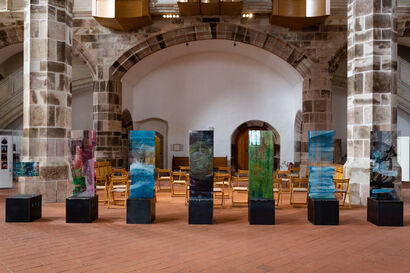
Arts Schneeberg. Groh's work explores biblical and poetic themes intertwined with personal and collective memory. Her artistic language is characterized by a sensitive engagement with materiality, transparency, and structure. Paper, fabric, and found materials form the basis of her compositions, marked by layering, open seams, and the deliberate visibility of processual traces.
She has participated in numerous national and international exhibitions, including in Venice,
Trieste, Zagreb, Livorno, Magdeburg, Chemnitz, Plauen, and Dresden. Her works are
represented in public collections such as the Klingspor Museum in Offenbach and the
Associazione Culturale Il Sestante (Italy). Groh has received several awards and grants, including the Mentor Prize of the West Saxon University of Applied Sciences Zwickau, project funding from the Alexander Tutsek Foundation, and the Premio Combat Prize (Italy). Sabrina Vivian Groh’s artistic practice is defined by a subtle balance between fragility and clarity. Her works invite quiet contemplation – as spaces where memory, spirituality, and material presence come into contact.
Artist statement
“To create – to be a creator – is a gift to those who are called to it.
Isolation. Time to observe, to reflect, to perceive.
The window to the outside: a welcome medicine everyone needs.
The gaze to the sky, by day and by night.
We write and quote what we perceive – with the pen, the brush,
the palette knife – with whatever falls into our hands.
Thank you for this time of slowing down.”
My artistic work moves between biblical narratives, personal memory, and the exploration of materiality. I am not interested in grand gestures, but in the quiet, the translucent, the fragmentary. I work with paper, fabric, wood, and found objects – materials that carry traces and make processes visible.
I understand transparency not only as an aesthetic tool, but as an attitude: openness to fractures, to the unfinished, to what does not immediately reveal itself. Memories – both my own and those I discover – flow into my works and become silent carriers of history.
Biblical motifs serve as a space of resonance: not as rigid dogma, but as open visual worlds that enter into dialogue with the present. In my work, I seek to create spaces where stillness, time, and sensory perception form a language of their own.