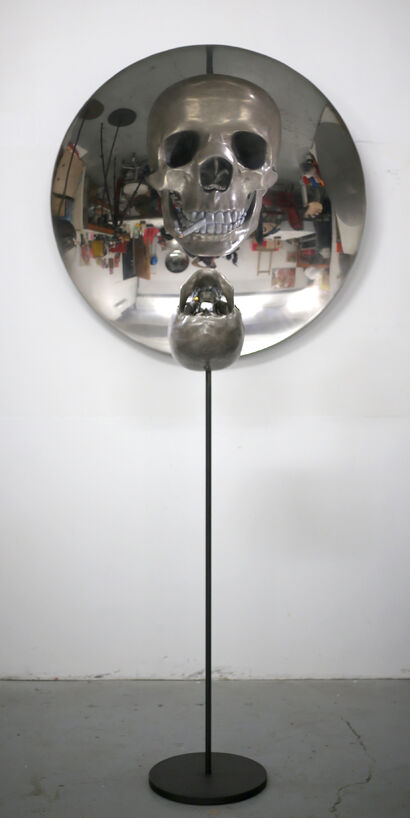
Louis Pratt and Nico Pietroni form a visionary duo at the intersection of contemporary art and computational design. Their collaboration unites the conceptual depth of one of Australia’s leading data artists with the mathematical precision of a pioneering computer graphics researcher. Together, they forge a new language of sculptural expression—one where light, form, and code converge to challenge perception and material boundaries.
Louis Pratt is an acclaimed sculptor known for his command of digital fabrication, illusion, and material hybridity. His works, often defying dimensional expectation, are imbued with socio-political undertones and technical sophistication. A recipient of major Australian art awards, Pratt’s practice is driven by a profound interest in human perception and its manipulation through form. His solo works span coal, bronze, data sculpture, and augmented reality, always blurring the lines between the tangible and the conceptual.
Dr. Nico Pietroni is an Associate Professor in Computer Graphics at University Of Technology Sydney. Internationally recognized for his contributions to digital geometry processing, Pietroni’s algorithms are embedded in tools used by Industry. His research focuses on the aesthetic and structural manipulation of 3D surfaces—transforming mathematical complexity into elegant, often fabricable, solutions. His academic practice merges computation and creativity, consistently pushing the limits of what is geometrically and visually possible.
The Collaboration
Their partnership began at the University of Technology Sydney during Pratt’s doctoral research. The duo bonded over a shared fascination for anamorphosis, visual deception, and the expressive potential of reflective surfaces. Their landmark collaboration, A Very Dutch Ghost, exemplifies this union—fusing vanitas symbolism with high-precision optics and digital fabrication. The piece—a concave mirror and distorted skull sculpture—reconstructs historical illusions through bespoke ray-tracing algorithms. It became a finalist in the 2023 Wynne Prize and has since exhibited in Italy and Australia to critical acclaim.
Beyond a single work, Pratt and Pietroni continue to develop a series of sculptural installations that operate in the liminal space between reality and its algorithmic interpretation. Each work draws from their respective domains—Pratt’s conceptual authorship and material knowledge; Pietroni’s control of light, reflection, and geometry—to create art that is not only seen but computed.
Their collaboration stands as a model for cross-disciplinary creativity—one that doesn’t just integrate art and science but fuses them into a singular, transformative practice.