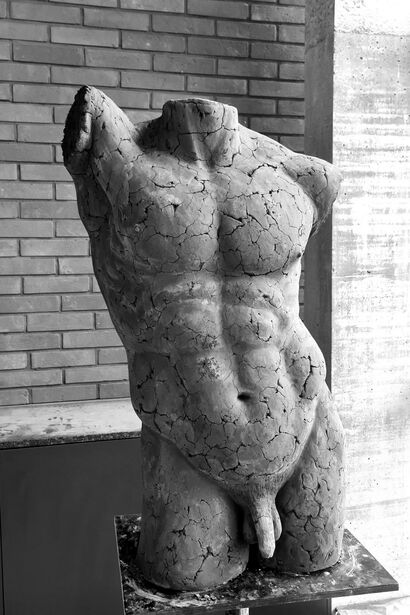
Marcin G. Otapowicz, born in 1978 in Białystok, is a vibrant and intriguing personality, an artist, inventor, entrepreneur, and sculptor who became interested in sculpture at the age of 10 and has been creating ever since. A seeker, exceptionally curious about the world, passionate about science, history, nature, technology, and scientific literature. He studied architecture and international relations, and is a member of the Association of Polish Inventors and Rationalizers.
Among the many fields of art and sciences that interest the artist, he has a particular affinity for the art of antiquity and the Renaissance, which remains his inspiration to this day. As he puts it, “a huge part of his life was spent in New York during his youth, surrounded by inspiring people, art galleries, museums, and the great world of art.”
At the center of the artist’s interest is the human being, emotions, the human body immortalized in sculpture. He longs for beauty, as he says, “in this modern and artificial world.” The creator has a special fondness for wood, reviving it, creating with the incredible material that is bog wood, often over 7000 years old! Bearing witness to history, the transformations in the history of humanity and the world, which is equally amazing inspiration in itself. The human depicted in the work of this artist is classical, statuesque, yet still alive, possessing a soul despite being encapsulated in wood, marble, or bronze cast. The figures are damaged, like ancient sculptures, often lacking hands, legs, body parts, they are contemporary yet appear aged. The author perceives the passage of time, the decay of matter, feeling that he is a witness to history and wants to be a part of it.
Particular attention is deserved for the artist’s workshop and precision, his incredible knowledge of anatomy, and exceptional sense of form. Currently, the author has his sculptures on every continent, having been commissioned for art for years.
Prof. Jan Wiktor Sienkiewicz, Ph.D.
Art historian, art critic, curator
**Petrificatus natura.**
Marcin Otapowicz - Sculpture
The landscape of contemporary Polish sculpture at the turn of the 20th and 21st centuries, as well as the last two decades of the 21st century, despite its smaller community compared to painters, reflects all the current trends and fashions present in world art. The renowned expert on contemporary sculpture in Poland, Dotora Thiede-Grubba, posits in her work *The Figurative Trend in Post-War Polish Sculpture* that "the areas of creative achievements in contemporary sculpture, which had been rapidly expanding in European countries and beyond since the early 20th century, began to take on a metaphorical form of a rhizome by the 1960s - branching out in various directions, making it difficult to define many sculptural works precisely" (Thiede-Grubba, 2016). This has led to issues with defining sculpture, especially concerning figurative elements.
Despite the dominant postmodern tendencies in the visual arts of the 21st century (understood in various modifications), figurative sculpture (in its various forms) remains significant both in Poland and globally. This includes the work of Marcin Otapowicz, a young generation sculptor working in Podlasie, Poland, outside the main academic centers. For over two decades, he has offered an individual approach to broadly understood classical art, both ancient and Renaissance.
Marcin Otapowicz focuses his sculptural compositions on portraits and full-body representations of the human figure, mainly male, based on the ideal of classical sculpture. These works, made in bronze, Carrara marble, and wood, adhere to classical canons of beauty and proportion. However, the artist consciously "mutilates" his male bodies and portraits. In full-body representations of the male ideal, Otapowicz "amputates" the limbs, making his marble, bronze, and wood compositions resemble ancient Greek and Roman sculptures found in fragments after many centuries. These pieces, often partially preserved, can be seen in museum collections worldwide, including in the United States, where the young artist first encountered ancient European culture.
For Marcin Otapowicz, born in Białystok, Poland, and educated partly in New York, the American perspective on the roots of European civilization at the turn of the 20th and 21st centuries had a significant impact on his artistic expression. His exposure to ancient art collections, especially in institutions like the Metropolitan Museum of Art, was crucial in developing his artistic voice, which he aimed to make accessible to contemporary audiences in a globalized world.
Ancient civilizations, such as Greece and Rome, whose material relics include architecture, sculpture, and mosaics, continue to inspire Otapowicz. Describing one of his compositions, *Hoppe - Terra* (2023), featuring a fragment of a female face with pronounced features and cracks, the artist emphasizes that "destruction can be a force of chaos, but art often emerges from it as a testimony of resilience and creativity. Throughout history, civilizations have risen and fallen, leaving ruins and relics that testify to their existence. In these remnants, we find art as a lasting expression of human ingenuity and spirit, reminding us that even in the face of destruction, human creativity endures, offering comfort and hope in adversity" (Otapowicz, 2023).
Marcin Otapowicz was born in Białystok in 1978. From an early age, he showed exceptional talent in the visual arts, coupled with a growing interest in science, history, nature, technology, inventions, and scientific literature. Fascinated by the world, he became a methodical seeker and enthusiast over the years. Among the various fields of art, science, and literature, he holds a particular esteem for the achievements of ancient Greek and Roman civilizations and the European Renaissance, especially the Italian Renaissance. As he puts it, "in my youth, I spent a significant part of my life in New York, surrounded by inspiring people, art galleries, museums, and the vast world of art." These experiences form the foundation of Otapowicz's artistic work.
In the "modern and artificial world" (as Otapowicz describes contemporary reality), his art primarily focuses on the human body in an inseparable symbiosis with its emotions and expression. The artist has a particular affinity for wood, which he sources specifically for his compositions. Often, this includes ancient oak, over 7,000 years old, making the "mutilated" torsos and bodies of the Polish sculptor, created with a masterful "gaze" at classical models, not mere contemporary reproductions of academic forms based on ancient copies, but carry a unique, individual symbolic code that is distinctive to Otapowicz, both in the themes of the representations and the material aspect of the ancient wood.
With great sensitivity and awareness, Otapowicz engages in a play of conventions in his figurative representations. On the bodies, especially those made of ancient wood—often a unique material found or recovered after centuries of submersion—such as in *Prometheus* (2022), *Ikarus* (2022), *Aeneas* and *Prometheus II* (2023), or in the ceramic portrait faces, like *Hoppe* (2023), or the bronze torso *Chronos* (2024), he employs effects of destruction, chipping, and a network of cracks.
In Otapowicz's sculptural oeuvre, the mentioned *Ikarus* stands out as one of his most "iconic" and masterfully executed works. This composition is a kind of homage to the art of Leonardo da Vinci, born from admiration for the Renaissance genius's achievements in various fields, including technical and constructional projects and concepts that were innovative for their time. Otapowicz sculpted the contemporary *Ikarus* from oak wood, which he specially charred and brushed. The wings of the ancient mythological hero were made from steam-bent oak wood mounted on a metal frame, covered with cotton fabric, leather strips, and jute rope.
A strong symbolic charge is also present in the earlier mentioned sculpture *Aeneas* (2023). The figure of Aeneas, taken from Greek and Roman mythology as a hero of the Trojan War and considered the son of King Anchises and the goddess Venus (Aphrodite in Greek), was a descendant of Dardanus and thus also of the god Zeus. The classically composed, strongly built male torso, in Otapowicz's sculptural vision, emerges from the heartwood of ancient oak, becoming a symbol of "the unspeakable bond between organic matter and the human 'vessel,' while the structure of the wood, marked by countless years, reflects the complex architecture of the human body. This wooden piece, styled as an ancient relic, serves as a poignant reminder of the enduring connection to nature, persisting long after our mortal journey ends" (Otapowicz, 2023).
Symbolic and contemporary references are also embedded in the artistic and symbolic layers of two other sculptural representations, *Prometheus* (2022) and *Prometheus II* (2023). Through these two compositions, the artist pays homage to the timeless myth of Prometheus, merging ancient narrative with modern artistic expression. Both unique compositions, meticulously sculpted from blocks of oak with the tactile sensation of the sculptor's chisel on the surface of the torsos, symbolize the challenge and creativity of the Polish artist, deeply familiar with ancient culture and the tradition of European civilization.
In the *Prometheus* composition, the mythological story of Prometheus stealing fire from the gods is transformed by the Polish artist into a message for contemporary humanity, highlighting the eternal human pursuit of knowledge and development. As the sculptor emphasizes: "Combining ancient mythology with contemporary craftsmanship invites viewers to reflect on the enduring significance of the Prometheus story in our rapidly changing world. And the wooden sculpture serves as a powerful reminder that, like Prometheus, humanity continues to push boundaries and challenge the status quo, seeking enlightenment and progress in the face of adversity." The question arises, do we need a modern Prometheus? – such a question is posed by the artist in the second Promethean sculpture, *Prometheus II* (2023). The answer, as the creator notes, "lies in the delicate balance between progress and responsibility. While the pursuit of knowledge and technological advancement is essential, it requires a guiding force to ensure its ethical application and to prevent unforeseen consequences. The modern Prometheus, embodying the spirit of wisdom, could indeed lead us towards solutions to urgent global challenges. Whether it be climate change, pandemics, or the ethical dilemmas arising from technological capabilities, his benevolent figure may illuminate paths to navigate the complex map of progress. Nevertheless, the Prometheus myth warns against unchecked ambition. The flame of knowledge, when used irresponsibly, can unleash destructive forces. Thus, the modern Prometheus must not only enlighten us but also instill a sense of ethical stewardship, ensuring that the flame serves humanity rather than consuming it" (Otapowicz, 2023).
Aside from a few compositions, such as the ceramic sculpture *Slave with a sword* (2018), Marcin Otapowicz, much like Igor Mitoraj before him, "references the forms of his works to antiquity to pay homage to the ancients and to measure up to the perfection of the greatest creators of past centuries" (Radwan, 2022). In his creatively interpreted classical art, Otapowicz's works in metal, stone, and wood demonstrate how the sculptural language moves towards an individual style, "drawing from what is the greatest European and world heritage, namely the art of Rome, the art of Greece, the sculpture that has survived from ancient