BIO
Mylène S. is a self-taught artist born in Schaerbeek, raised in Wavre, and now based in Quiévrain. She has been painting for over 25 years in an instinctive, free, and deeply personal way.
From adolescence, painting became a physical and emotional necessity. Despite studying Fine Arts and Art History, she chose to follow her own path, away from rigid frameworks. She also studied social sciences, trained as an assistant director, and raised her children while traveling—blending family life with an ever-present, sometimes discreet but never dormant artistic practice.
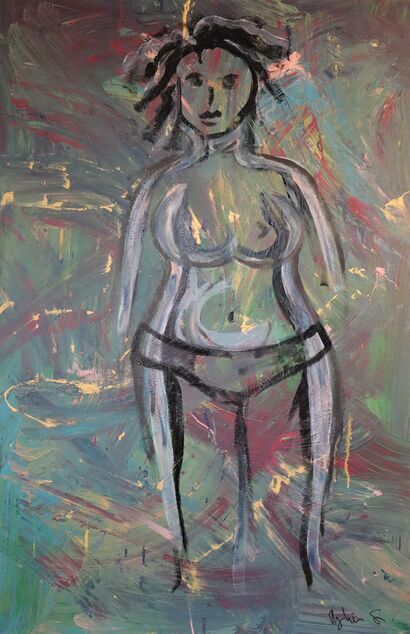
Her work plays with abstraction, color, textures, and sensations, often created to music, as if transforming sound into form. Inspired by intimate experiences and social reflections—non-normative bodies, women’s place in society, spontaneity as an act of creation, humor as a gentle weapon—her art is both sensitive and engaged.
Painting mainly on reclaimed wood, using acrylic, oil, lacquers, and inks, she creates unique material and movement effects. After years of keeping her work private, she began exhibiting in group shows in Belgium and is now taking a decisive step: revealing a singular universe where everyone can project their own emotions.
Artistic Approach – Mylène S.
My artistic practice is deeply rooted in abstraction, the interplay of colors and textures, and the expression of emotions. I often paint based on very personal feelings, sometimes inspired by music. Some of my canvases are, in a way, a visual translation of pieces of music that have moved me – as if I were transforming sound into matter.
My artistic universe is constantly evolving. After experimenting with figurative, childlike art, I felt the need to merge this approach with abstraction. This exploration led me to study bodies that are often absent from dominant representations: marginalized, forgotten, non-idealized bodies. What began with a self-portrait became a statement on norms, social representation, and invisibility.
Some works also address feminist and societal issues, sometimes using dark humor or absurdity. One series of miniature penis-shaped tags, originally created for a group exhibition, became a way to question the rise of masculinism and the still fragile place of women in public and artistic spaces.
What I seek to convey above all is emotion. Energy. My darker paintings may evoke depression or doubt, while others are joyful, naive, or open to free interpretation. I like that abstraction allows personal projection: everyone can see what they want—or need—to see in it. What matters most is that it resonates.
From a technical perspective, I use varied materials: acrylic, oil paint, varnishes, inks—depending on the desired effect. Layering, playing with textures, and the chemical reactions between different coats are central to my research. I almost exclusively paint on wood, often salvaged, which gives my works a strong physical presence and a second life to the material. Working on non-standard supports (irregular shapes, the constraints of the material) offers a unique source of creative freedom.
I have been painting since adolescence. It was an immediate, almost physical revelation. Despite studying at the Beaux-Arts, I remain attached to a sense of spontaneity: I don’t really choose when I create—it's inspiration that dictates the rhythm, even at 2 a.m. My style has naturally evolved over the years, shaped by experiences, loss, intimate transformations, music, and the emotions I have lived through. I deeply believe one is never the same artist from one canvas to the next.
As for a common thread, my work features recurring chromatic elements: blue, red, and black dominate, sometimes enriched with gold or silver. Green—though it was the color of my very first painting—is almost entirely absent today, an involuntary nod to my beginnings, perhaps.
The Presentation of My Works
I refuse to exhibit my paintings in a sterile, frozen setting, as is too often seen in catalogues: a minimalist living room, cold lighting, a soulless décor. That doesn’t reflect who I am. My work is alive, in motion, crossed by emotions and contradictions — it cannot be locked into an overly perfect image.
I prefer to show my canvases in lived-in spaces, in movement, where everyday life mingles with art. A slightly worn sofa, a child reading, a big teddy bear, a conversation, a suspended moment… These are the fragments of life that, in my view, reveal the true power of painting: its ability to take root in reality, to engage in dialogue with those who pass by, who pause, who look.
My works are not meant to be untouchable or intimidating. They are there to resonate with the world, to confront it. Their place is in the midst of life.