Teresa
Maresca, painter has been living and working in Milan, Italy, since the 1980’s.
One of her first pictorial cycles, FERRO, is inspired by the landscape of industrial archaeology, and was set up at the ex-Falck fabric in Sesto and the MUSIL, Museum of Industry and Work in Brescia.
She created a cycle, AMERICANA, on the journey "on the road", followed by SWIMMING POOLS, large-format acrylic works and photographic collages, exhibited at the Museum of Cinema in Brescia, and at the Raccolte Frugone of the Civic Museums of Genoa Nervi.
The cycle SONG OF MYSELF is dedicated to the theme of nature in American transcendentalist thought and in the poems of Walt Whitman. SONG OF MYSELF was exhibited at the Galleria d'Arte Moderna in Genoa and at the Acquario Civico in Milan. She collaborated on a project on Paleolithic rock- art, with Prof. Fiorenzo Facchini, of the Natural History Museum of Bologna, and with Prof. David Whitley, ASM, Carlsbad, California. Two works on the theme were exhibited in the Italian Pavilion at the Venice Biennale. She held a solo exhibition at the Museo Diocesano in Milan. She also set up "The Cave in the Mind, Art from the Cave" at the Teatro Menotti in Milan, with the contribution of the poets Maurizio Cucchi and Roberto Mussapi, and at the Passante Sotterraneo of the Milan Metro. On the topic of art and environment, she has held several conferences at the University of Milan, and has published a book, “Il Primitivo del Sogno”, Algra editore, on Nature and Art, from Rock-Art to the 70s.
POETIC STATEMENTS
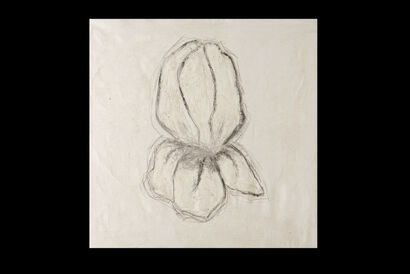
Paleoanthropology defines its field of study as “Stones and Bones”. Starting from these premises, its scientists and historians of religions have arrived at the determination of an intentional and conscious symbolic universe of Homo sapiens, as is also evident by looking at the extraordinary animals depicted on the walls of rock art caves. I wonder what attracted me to this aesthetic universe in its early days, if not precisely this essentiality that makes you feel immediately close and near what in terms of time is immeasurably distant, this ability to express oneself with a few perfect signs that leave you speechless both for the grandeur of the project and for the investigation into meaning, a field that still needs to be explored in depth. Furthermore, I am fascinated by this stubborn will to express themselves of my artist ancestors, without a shared aesthetic, without a symbolic world to draw from, without the technical means, without anything. The rock art that I had studied for years, one day jumped into my mind. The essentiality of the signs engraved on the caves, their primordial, more than primitive, force led me to eliminate everything that I could consider excess; all the color, the shadows of the volumes, the entire way of working on the canvas that I had laboriously achieved was as if swept away, reset, to arrive at a single color, white, and a single substance, fundamental, bony. The subjects of Flowers&Bones were born: skulls of bovids stripped by time, bisons especially, and flowers, botanical flowers, real flowers from botanical texts, whose features somehow on my canvas recall vertebrae, ribs, jaws, pelvic basins, iliac bones, and which have in common with the bucrania the same color, white, and the same technique, sand, ash, chalk. One attracts the other, as in a baroque reference between life and death. The promise of the flower and the end of the bone, together in a single vision.
LAVA, SAND AND BITUMEN IN MY STUDIO
Making art for me is feeling part of a natural exterior. This is why I carefully observe the texture of the bark to draw a Poplar that is a Poplar, not just any “plant”. This is why I want the chemistry of this natural exterior to enter directly into my work. In addition to the colors in the tubes, and the canvas and other painter's elements that I find in the paint shop, I use tar, an organic material that is obtained from the distillation of fossil coal, and that I hope will evolve perhaps by regenerating itself . I also like to use bitumen, en element of fossil origin, for the oxidized and slightly transparent color that I don't find in any other pigment. I use volcanic lava, cooled magma, a mix of minerals from the earth's core, with a brown and opaque color, in which I sink my hands before mixing it with other excipients or glues. . I use chalk, calcium sulphate, and marble dust, the calcareous dust rich in calcium carbonate, for their consistency and their natural whiteness. I oxidize copper, to obtain the turquoise-green on the plates. I wait for the rust to form, which is created on the iron plates on which leaves and rain fall. I needed it to draw a pond from which the stem of the Lotus germinated, the flower that blooms only on the surface. The bitumen gave me the viscosity of the pond and the rust the tangle of submerged vegetation. I do not use tricks to block the natural evolution of these elements on the painting, I like to imagine how that rust can spread or how the color of that bitumen can change. All living things are animated, they move, they reproduce, they communicate, they are born, they die. Even on my canvas.