Born in 1976, Timothée lives and works between Paris and the Normandy countryside. His exhibition journey began in the 2000s, notably in group exhibitions with the Area gallery at Art Paris Fair, as well as in Geneva, Beirut, and Seoul. He has also participated several times in the MacParis artists' fair. His latest exhibition took place at the MacParis fair in early June 2023 at the Bastille Design Center. In 2025, he will exhibit in Art World Fair Paris, Artists Meetings Knokke, and Arte Genova.
A particular attention is given to using environmentally friendly and local materials: Bio-based binder manufactured in Normandy. Linen canvas manufactured in France. Pigments that pose no danger to humans or the environment. Recycled paper.
When Timothée started this series of paintings, he immediately thought of the Verdures, the Renaissance tapestries characterized by dense, almost luxuriant foliage motifs.
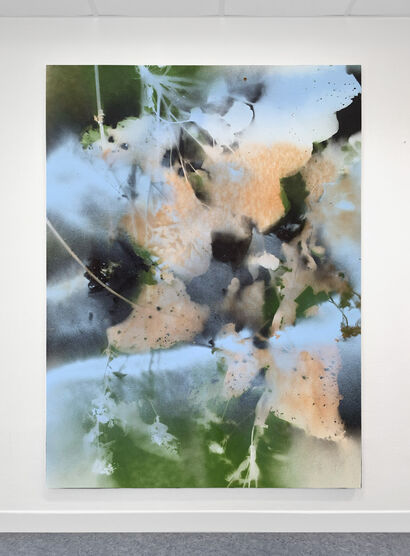
This stencil and imprint approach creates a rather complex chaos, aligning with the notion of working within an undergrowth, which feels logical. The painter works outdoors, engaging with the motif in a manner reminiscent of 19th-century landscape painters, yet he creates the paintings 'with' nature rather than 'from' it. This method allows for a kind of landscape art that could be classified as abstract landscapes.
These works utilize prints and stencils with spray paint. Each branch, leaf, and tree possesses its own vocabulary and language—there is no reproduction or drawing involved. The environment is not imitated but presented. The proximity of the plants to the canvas generates a rich variety of density.
The element of chance and surprise is central to Timothée’s process; it is the unexpected that makes the endeavor engaging, and this element of surprise is something he actively seeks. Importantly, this is not a deliberate choice.
Each species of tree and plant contributes its own identity and signature to the artwork. The iconography of branches creates a somewhat organic narrative, with shapes, patterns, and contours deriving from the garden surrounding the painter. Luminosity and depth emerge from the use of color, while composition remains highly unpredictable.
A rock, a cloud, or the silhouette of a tree resembling a face may evoke banal yet instinctive visual effects. Observing a painting can produce visual sensations akin to gazing at a rock ridge; both experiences elicit similar instinctive responses. Timothée’s paintings are not intended to replicate but rather to evoke feelings, creating a resemblance in sensation rather than representation.
The artwork can encompass views ranging from microscopic details to celestial constellations. This versatility is striking, as it can evoke thoughts of the unseen—representations of microbes or celestial bodies, often accessed through reproductions. Ultimately, these paintings encourage contemplation of the infinitely small and the infinitely large, from the micro to the macro. Foliage serves merely as a tool to evoke a more universal connection. This outcome is entirely unplanned and emerges naturally; it is not the concept that shapes the painting but rather the painting that defines the concept.
Timothée envisions that viewers might recognize familiar shapes, though sometimes nothing specific can be identified. Still, there is an evocative quality that activates a mental image—a detail within the painting that associates with or recalls something else. This recognition may be intangible and inexplicable.
In this way, it is fair to describe these works as open-ended, inviting interpretation. They can trigger vague, indistinct memories without tying to a specific scene, reflecting what the unconscious desires to interpret. This aspect can become intensely personal, transforming the canvas into a mirror for the viewer's experiences, allowing the work to function as a catalyst for memory and self-reflection.