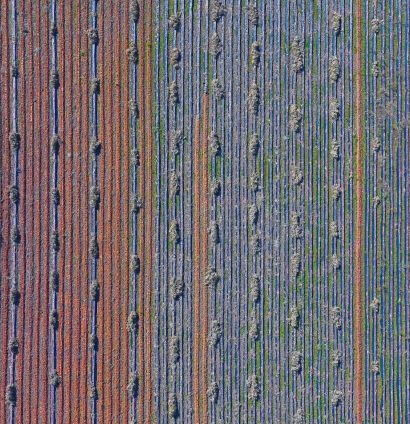
Poung-young Kwak is a visual artist who reflects on the relationship between humans and the environment through a gaze from above. Rather than representing landscapes as objects of beauty, his work begins by viewing them as recorded surfaces shaped by accumulated human decisions, technologies, and time. For Kwak, aviation and drone technologies are not merely tools for image-making but instruments of thought devices through which the world is interpreted. He continually asks what it means to look at the world after ascent, and how vision must change once humans have risen above the ground through technology.
Kwak’s artistic orientation resists positioning nature and humanity as opposing forces. Rice fields, salt flats, glaciers, arid farmlands, and olive groves—the primary subjects of his work are sites where human intervention and natural conditions operate simultaneously. He avoids framing these landscapes through binaries of destruction and preservation. Instead, he reads them as complex structures where labor, systems, climate, and ecology overlap. As a result, his photographs do not accuse nature of fragility nor condemn humanity outright; they quietly reveal the conditions of a world that has already been shaped.
Formally, Kwak’s work constructs an abstract visual language through repetition, alignment, fragmentation, and balance. Yet this aesthetic does not remain at the level of visual pleasure. Viewers may initially be drawn to the order and harmony of the images, only to find that the social and ethical implications embedded within that order cannot be grasped at a glance. Kwak believes that thought begins precisely at this moment of misalignment between beauty and understanding. In his practice, aesthetics are not vehicles for delivering messages but conditions that interrupt perception and provoke renewed questioning.
A core value in Kwak’s practice is the rejection of speed and the embrace of contemplation. He chooses to record slow, repetitive processes of change rather than dramatic scenes, immediate emotions, or direct assertions. In works addressing the climate crisis in particular, he presents it not as a singular event but as an ongoing condition. This approach is not intended to shock the viewer, but to ethically insist on sustained attention toward changes we have long avoided confronting.
Ultimately, Kwak’s work does not ask how far humans can fly. Instead, it asks what we must take responsibility for once we have gained the ability to rise. His gaze operates not from a position of dominance, but from a distance that allows reflection. Through this stance, his work invites us to reconsider how humans, in the aftermath of technology, relate to the world they inhabit.