About the Artist
I am a visual artist specializing in performance video and installation. I spent my formative years in New Zealand surrounded by incredible nature, which has shaped my interest in the relationship between humans and the environment. Since returning to my home country of Korea as an adult, I have been exploring the impact of fast-changing urban existence in modern times on individuals’ dreams and social issues. The goals and ideals that humanity strives to achieve may be specific to a single generation or passed down through several generations; whichever is the case, individuals are the actors that manifest society’s aspirations. As an artist, I believe that humans exist not for the purpose of building an ideal world, but rather challenging the power of socially enforced ideals and virtues. I also believe that the essence of creativity lies in investigating life itself and that artistic struggle is always a struggle against oneself. At present, I produce installations using videos I filmed and objects I made in Seoul and Busan. My research focuses on developing and refining my artistic expression by visualizing concepts that defy easy conceptualization such as time, light, and life.
Early Works: Faces
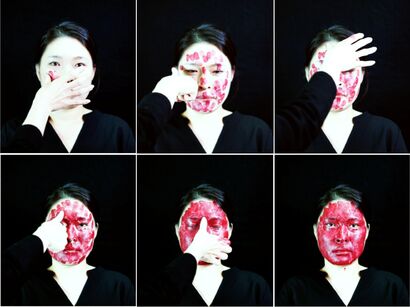
My early works focus on the human face as canvas onto which I express social signals. In Knotting Face (2018), my face is gradually covered with other people’s red thumbprints until the marks coalesce into a red mask that obscures my face underneath. Hair on Me (2015) features two performers, one male and one female; the man’s facial hair, a symbol of masculinity, is systematically removed and transplanted onto the woman’s face, strand by strand, until the latter appears hairy and the former is bare. Letters from Poets (2019) showcases the faces of seven acquaintances that I invited to my video funeral; this seven-channel video installation presents their dialogues, interviews, and speeches about me and my life. Furthermore, Video Letter Project New York (2019–2020), made possible by support from Arts Council Korea (ARKO) and Residency Unlimited (RU) in the United States, involved visiting a New York senior center and speaking with octogenarians who had spent significant parts of their lives far from their birthplaces due to various historical events. As a part of this process, I produced video portraits of each individual and delivered them to their loved ones in their home countries.
Video as a Medium
I believe we can understand life only through our personal experiences. As a creator, I aim to lend visual and artistic language to one's unchanging identity, or sense of self, that remains constant throughout our continued relationship-building in the outside world. My early works, which engaged with the face as a medium, sought to express a sense of self capable of manifesting more clearly vis-à-vis diverse relationships with others, proposing that it is impossible to connect with oneself without the mediating influence of external relationships. I began this exploration first with my own face before expanding my purview to observe the faces of other people in my community as well as beyond. Relationships drive me to experiment with and expand upon the characteristics and potential of a video as an artistic medium; in addition to recording time, projecting light, and even disappearing due to its lack of a definite physical form, video continues to exist in nonphysical places, sometimes even hidden away in someone’s memory. Time cannot be seen but it exists everywhere. The time-recording function of video enables artists like me to document and subdivide invisible time so that past and present coexist, allowing viewers to envision both a past and future that they have not directly experienced. Through my video works, I try to overcome the limitations of an incomplete and structured social language in order to express my own artistic struggle, which has yet to crystallize into a clear concept.
Videos use light to record time and space. Time, which is impossible to locate yet omnipresent, can be compared to videos that exist as projections of light that quickly disappear. By filming from multiple angles, editing, and connecting fragmented footage, one can travel between the past and the future and even overlay an unexperienced past and a possible future, perceiving them side by side. Moving images also bear similarities to human memories, since both enable us to traverse the dimensions of our subconscious, conscious, and dream states. Internally “fragmenting time” is an almost instinctual human activity whenever one faces the various limits of an imperfect life; confronted with countless questions and uncertain answers in our lives, we fragment time as a method of searching for explanations.
Korean-English Translation of this text is supported by Ministry of Culture, Sports and Tourism and Korea Arts Management Service'