I was born in Ivory Coast, 1979 from a polynesian dad and a french mum, then I grew up in several islands around the world, especially in Pacific Ocean. As a child, I was profoundly shaped by the landscapes, the...
Read MoreI was born in Ivory Coast, 1979 from a polynesian dad and a french mum, then I grew up in several islands around the world, especially in Pacific Ocean. As a child, I was profoundly shaped by the landscapes, the cultures, and the histories of those islands. At fifteen, when I first began to paint, every canvas carried the name of a city in Africa, Australia, or Latin America - lands I dreamed of, places I imagined as radiant with culture and beauty. With time, I came to understand that what called to me in those visions was not only aesthetic, but deeply political.
What have the peoples of these seaside paradises endured? What destinies unfolded under colonization, and what imprints has history carved into their memories? How is decolonization lived when one cannot foresee its consequences? Who do we become when we belong fully to neither one culture nor another, but are instead inhabited - colonized - by a weave of many cultures?
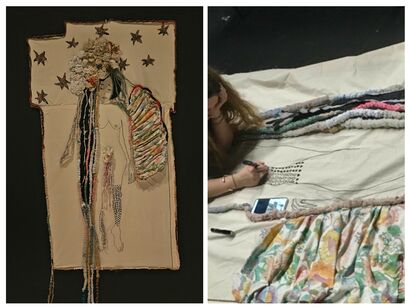
This is the core of my practice today. I work with canvas, but I refuse to confine it to painting alone: I sculpt it, tear it, twist it into cords I call roots, that I assemble into new forms. My inspiration often flows from Jungian psychoanalysis, and the notion of the collective unconscious. I am also guided by ecofeminism, which I see as the new humanism of the twenty-first century. And I turn to language - through poetry, countless poems - as a way to question history, nature, the sacred, and the living itself.
At forty-six, I feel I have reached the threshold of my practice, having finally found my voice after years of searching, questioning, and reading. To take part in exhibitions is, for me, to step into a collective rhythm - to join an artistic and aesthetic momentum, and to embrace a form of political expression that dares to speak its vision of the world.