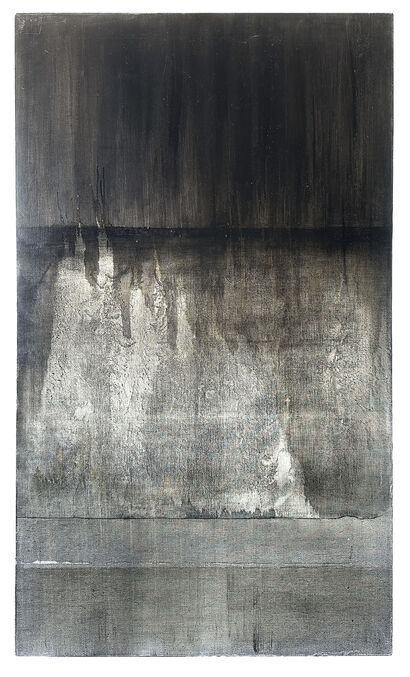
Nastazja Ciupa (1991, Katowice)Live and work in Warszawa. She works in the fields of artistic printmaking and painting. She completed her diploma at the Jan Matejko Academy of Fine Arts in Kraków, specializing in the Lithography Studio, with an additional...
Read MoreNastazja Ciupa (1991, Katowice)
Live and work in Warszawa. She works in the fields of artistic printmaking and painting. She completed her diploma at the Jan Matejko Academy of Fine Arts in Kraków, specializing in the Lithography Studio, with an additional focus in the Studio of Advertising Forms. She earned her doctoral degree at the Academy of Fine Arts in Warsaw with a dissertation titled "The Identity of My Non-Place", supervised by Professor Błażej Ostoja Lniski.
She currently works as an assistant in the Lithography and Unique Publications Studio at the Faculty of Graphic Arts at the Academy of Fine Arts in Warsaw.
Her primary medium is stone lithography, which she treats as a space for reflection on memory, space, and landscape – often aligned with the concept of the open work, both formally and mentally. Her art is inspired by personal experiences and emotions, and explores themes such as memory, emptiness, and identity.
She is the recipient of the Grand Prize at the 7th International Graphic Art Biennial of Szeklerland (2022), and received honorable mentions at the 5th International Mini Print Cantabria (2022) and the 3rd International Lithography Biennale of Belgrade (2022).
Nastazja has participated in numerous national and international exhibitions and is a member of the Intergrafia Association.
She works in the fields of artistic printmaking and painting. She primarily creates using the technique of stone lithography, treating it as a medium for reflecting on memory, space, and identity. In her prints, she constructs mental landscapes – places filtered through memory, distorted by time and imagination. She references Marc Augé’s concept of non-places – anonymous spaces where identity dissipates. It is precisely within such spaces that I search for traces – not in the form of linear narrative, but as fragments, afterimages, signs of presence.The art she creates does not reconstruct reality. It is an attempt to capture what is fleeting: emotion, absence, emptiness. The image does not document – it rather evokes, reconstructs, and obscures. Memory becomes an image, and the image – a form of continuous remembering and forgetting.