Now
settled in the Drôme, Cécile Gissot was born on February 5, 1972,
in Saint Mandé, near Paris, to a father from Gers and a mother from
Jura. While her brother and sister found their paths early on and
embraced remarkable scientific careers, Cécile’s journey unfolded
in a very different way.
The
Time of Learning and Uncertainty
Artistic
longing was always quietly present in her life, yet the idea of
making it her vocation seemed out of reach - dismissed before it
could even become a dream. She followed a classical education: German
as her first language, a scientific baccalaureate… And then, what
next?
During her final year in lycée, she was deeply moved by the
expressionist movement while studying Murnau’s film “Nosferatu.”
This experience gave her a reason to pursue German literature at the
Sorbonne, without much conviction or success.
Something in
audiovisual, especially sound (strangely not image), began to call to
her. These studies led her to Radio France, where she worked as a
sound technician for twenty years. She nourished herself culturally,
discovering the beauty of silence, minimalist music, and the
repetition of motifs. Surrounded by passionate people, she realized
her own passion was not behind the mixing console.
But
irregular hours of the job allowed her to quietly nurture her
artistic practice alongside her radio work.
A
Path Reveals Itself
At first
self-taught, Cécile attended evening life drawing classes at the
Beaux-Arts in Paris then completed a decorative painting course at
IPEDEC. After visiting an exhibition of prints, engraving suddenly
felt like an obvious choice. She built a solid foundation at Joëlle
Serve’s Atelier 63, then met the Danish engraver Torben Bo Halbirk.
As a gentle mentor, he guided her for nearly ten years, helping her
discover her own artistic voice. In Bo’s collective studio, artists
from all walks of life crossed paths and shared ideas. The world of
possibilities opened up, and her hand grew freer.
Then came her
exhibitions (France, Denmark, Luxembourg, Finland, Estonia, Croatia),
workshops (Finland, Germany), biennials, and art libraries.
She
discovered the magical light of the Nordic countries, which
fascinated her and inspired her mezzotint series “Les Fenêtres”
(“The Windows”).
A
New Direction
Cécile soon found
support to retrain in the art of stained glass. She left Radio France
to join a stained glass restoration workshop in the Drôme, near the
mountains and rivers she had longed for. Her drawing and painting
skills found new purpose as she created designs for the company, and
she devoted herself to stained glass, setting aside her personal
artistic work for a time.
The
Time of Independence
After seven
years, thanks to meaningful encounters and the encouragement she
received, Cécile found the courage to start her own artistic career.
She rediscovered the creative work she had tucked away for so long.
A
“Fresh” Eye - Sources of Inspiration
Where
to begin, with a “fresh” eye?
She tore up her old editions of
engravings that no longer spoke to her, using them as backgrounds for
new projects - gluing, scratching, painting, working on large
formats. The Marcilly tree appeared (based on an engraving made in
Bo’s studio), two meters by two, a pillar.
Moved by Christian
Bobin’s text “La Présence Pure,” she drew the writing, the
words, endlessly copying the text onto a large piece of cardboard.
Then came portraits of her father, who had lost the ability to speak
due to illness.
The
call of the sensitive world became clear. Every force, every energy,
every living element deserved to be welcomed in the intimacy of the
moment that passes through it. She tried to let things come, without
always knowing what the result would be. Some motifs evolved through
gentle repetition, others simply sprang forth.
An
Evolving Work
In her presentday
studio, Cécile surrounds herself with faces seen as auto-portraits,
each with an intense, searching, penetrating gaze, drawn, painted,
large, small, created with untreated natural materials. It feels
finally the time to look oneself in the eye, to stop running away, to
accept what appears.
Her creative process, always intuitive, is
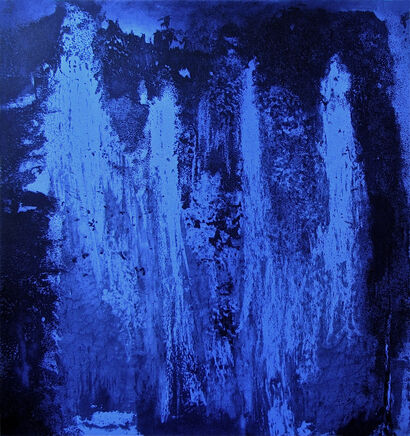
revealed by her work as it evolves. Through mezzotint, she explores
a particular light that emerges from the shadows of the sky and land,
enchanting and soothing, offering dreamlike horizons. By layering,
the material tells and releases what could not previously be
expressed.
Today, her work pushes her to discover herself, to tell
(herself) who she is.