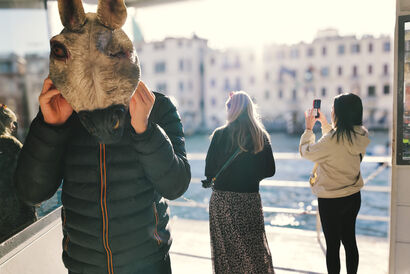
nora*c is a visual artist and theatre director. Her practice moves across languages and thresholds: photography, performance, writing, stage. She works with what remains at the margins of representation — detail, error, the formless — to build a sensitive grammar of the real.
After ten years of training and theatrical research with Angelo Nin Scolari, she has developed a radically corporeal and relational approach to the stage, one rooted in presence, dilated time, and the possibility that something may occur between the one who watches and the one who acts. Her workshops are devices for listening and traversing the human condition: experiences in which representation withdraws to make room for expression.
Photography, too, is born from this tension: not as illustration or ornament, but as an exercise in attention, an emotional seismograph. Her work explores contemporary anthropological dynamics with a lateral gaze, never didactic. Images do not aim to explain, but to evoke. Each project is a field of forces, a slow construction, a montage of relationships.
Through photography, she crafts intimate and porous narratives, capable of giving space and voice to what is often left at the edges. Her projects emerge from direct relationships with people and places, from an attitude of listening and suspension of judgment.
For nora*c, photographing is a daily act of silent resistance — a way to inhabit time, to bear witness to what risks disappearing. Her photography is neither decoration nor documentation: it is an act of unveiling, born of urgency — to cross the visible in order to reveal the invisible. It is a daily and radical gesture. It does not attempt to explain the world, but to listen where the noise is faint — in the cracks, at the edges, within silences.
She is drawn to identities that do not scream, to those who find no place under the spotlight. She is drawn to vulnerable bodies, wounded cities, oblique gazes. She is drawn to research, to paths and processes, wherever her reflection on the world decides to lead her. In this sense, the image is not truth but friction, not synthesis but opening. It does not console, it does not close, it does not save: it reveals.
And in this fragile and necessary gesture lies the very meaning of her art.