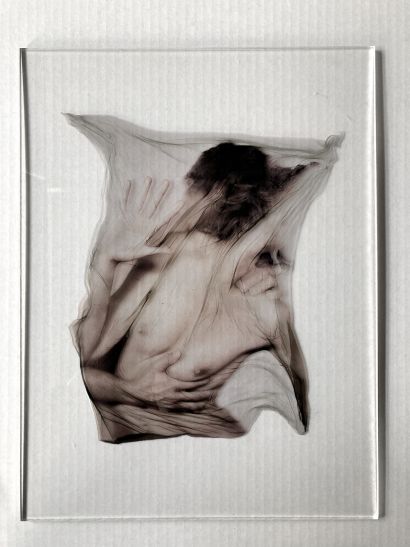
After studying cinema at the National Institute of Performing Arts in Brussels, Patricia Canino edited several feature films in Belgium, including Chantal Akerman’s “Jeanne Dielman.” She then directed short films about art, notably “On n’a que soi: Fernand Khnopff,” which...
Read MoreAfter studying cinema at the National Institute of Performing Arts in
Brussels, Patricia Canino edited several feature films in Belgium,
including Chantal Akerman’s “Jeanne Dielman.” She then directed short
films about art, notably “On n’a que soi: Fernand Khnopff,” which won
the “Grand Prix for image quality” at the International Art Film
Festival (Museum of Modern Art in Paris), and “La sainte veille sur la
ville endormie,” commissioned by the Musée d’Orsay in Paris.
When she
dedicates herself to photography, she retains a sense of staging,
framing, “off-screen” space, and especially her work with light, which
sculpts forms, accentuates contrasts, and enhances the brilliance of
fabrics. From interior architectural photography to the architecture of a
dress, her first fashion photography work was commissioned by the
publishing house “Les Éditions du Regard”: a book dedicated to the work
of Madeleine Vionnet. It reveals the composition of lines and forms of
the dress laid flat, in transparency and volume, but where light always
directs the gaze. Patricia Canino inaugurates a new way of bringing the
photographed garment to life into “still life.”
When she works
with the 20 x 25 inches Polaroid process, using lighting from cinema,
she discovers the possibility of transforming the very body of the
image. Lighting capture the vibration of fabrics and the sensuality of
skin. Long exposure times and the Polaroid process open the possibility
of creating a metamorphosis of forms and colors to evoke a more unreal,
more poetic world. The transfer of Polaroid emulsion onto watercolor
paper adds another dimension. The image becomes tactile, like that of an
engraving, a fresco, or a charcoal drawing.
In 1999, she received
the “Best Color Print” award with a fashion series for Issey Miyake at
the 6th edition of the “European Polaroid Final Art Awards.” In 2000,
she received the “European Best Color Print” award at the “First
Polaroid International Photography Awards” at the European House of
Photography in Paris.
In 2022, her original large-format Polaroid
works (50 cm x 60 cm) were acquired by the Museum of Decorative Arts in
Paris into its permanent collection.
She undertakes commissions
for several museums, including the Louvre Museum, the Museum of
Decorative Arts, the MET in New York, and participates in numerous group
exhibitions in France and abroad, as well as auctions at Artcurial in
Paris and Sotheby’s in New York.
From shooting to printing on the
most unexpected materials, her images become a place of experimentation.
Influenced by painting and cinema, she works with both analog and
digital techniques and uses both photographic and no photographic
processes, moving towards an increasingly plastic approach to the image.