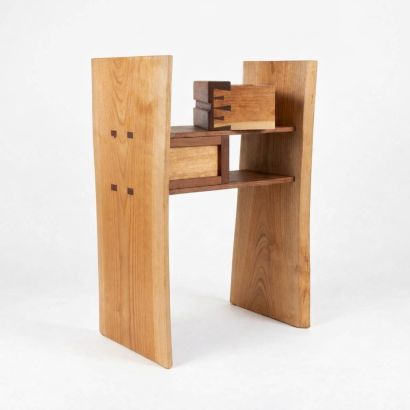
In an era of digital precision and industrial uniformity, I'm introducing my collection that offers a rare and radical counterpoint: "Handmade back into Collectible Design."
I am Giuseppe Deepak Benti, an Italian artist and unplugged cabinetmaker, born in India, adopted and raised by an Italian family, and living in Bergamo.
While remaining largely unrecognized in Italy, which is not surprising, the international community has embraced this "slow" philosophy, as I am internationally awarded and published in my field.
Every piece I create is born exclusively from the use of hand tools only.
From stock dimensioning and preparation of hardwoods only, made with hand saws and hand planes.
To hand-cut joinery, like houndstooth dovetails, half blind and standard dovetails, round and square mortise and tenons, dadoes, and grooves performed with hand saws, chisels, and joinery hand planes.
To organic finishes, like pure beeswax applied with simple cotton clothes.
I apply the same techniques used in the 18th Century by fine cabinet makers, but to contemporary lines and designs.
No machines or power tools are used.
In my view, they replace or reduce human abilities in favour of productivity.
This path was not merely a choice of aesthetics; it was a necessity for my survival.
During the C19 pandemic, I faced a severe form of anxiety that took a devastating toll on my health, leading me to lose 20kg in just a few months.
I found my remedy in the unplugged and silent labour of the hand plane and the chisels.
The sound of the mallet hitting the gouges and chisel heads became a harmonious symphony to my ears.
Unplugged woodworking became my meditative anchor, a way to rebuild myself and realize that I am unique, like all of us, as I built one-of-a-kind pieces.
I do not strive for machine-like perfection.
Instead, I seek the soul of the material through visible hand-cut joinery, such as houndstooth dovetails and mortise-and-tenon joints, and the unique grain texture caused by total hand plane work, not just in the final steps as usually performed at best.
To me, the handmade process is the art itself.
Each piece is a unique, one-of-a-kind creation that preserves traditional techniques that are increasingly lost in a world of mass production.
I am honoured to have my work featured across several issues of Furniture and Cabinetmaking Magazine, including a cover feature in Issue 328, and to have received an international Award from Wood Review.
I invite you to explore the evolution of these pieces through my Maison et Objet Shop, on Pamono, Chairish and Arte Laguna World, and my Instagram profile at the links below.
One of my latest works, "DAWN", represents the evolution of this journey.
It is a piece made entirely with hand tools from start to finish, a testament to what is possible when we unplug and listen to the material.
Here you can watch a 3-minute-long reel regarding the making of DAWN
https://www.instagram.com/reel/DVZQf-qDKkg/?utm_source=ig_web_copy_link&igsh=MzRlODBiNWFlZA==
Plus, my latest piece, “One, Two, Three, En Garde”, is a truly handmade and collectible chessboard with live edges and chess pieces.
What makes it unique?
It’s the result of 100 hours of pure unplugged work.
In one, two, three words: Handmade Functional Art.
It has three distinct functions.
Hung on the wall as an artistic frame with visual depth.
Vertically standing on a sideboard or on an elegant side table.
Then you can put it flat on the floor, and with a meditation pose.
You can open the drawer with half blind dovetails in contrasting wood tonalities, take the chess pieces, which I hand-cut and carved, one by one, put them on the chessboard and start playing.
When you are about to put the adversary queen under attack, then you can say “En Garde!”.
Here’s the link to the Instagram reel that shows the making of the piece in around 150 seconds.
https://www.instagram.com/reel/DYAZf9rMfRF/?utm_source=ig_web_copy_link&igsh=MzRlODBiNWFlZA==
I know this radical and provocative approach is not efficient in our “Everything-now " mindset.
But transforming it into collectible and functional art, truly handmade, can help these techniques be kept alive and then passed on.