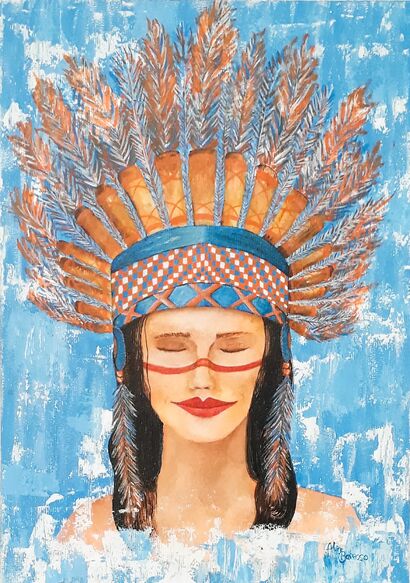
Aline Barroso (Brazil) is a visual artist whose practice moves between painting and photography, investigating the relationship between perception, presence, and the subtle states of experience. Her work unfolds through intuitive and contemplative processes, in which image, color, and gesture...
Read MoreAline Barroso (Brazil) is a visual artist whose practice moves between painting and photography, investigating the relationship between perception, presence, and the subtle states of experience. Her work unfolds through intuitive and contemplative processes, in which image, color, and gesture operate as devices to access dimensions of reality that are not immediately visible.
Her research reflects on the act of seeing and its multiple layers, shifting the image from a purely representational field toward a sensorial and experiential territory. Within this context, her works challenge the boundaries between the visible and the invisible, the act of recording and that of revealing, creating situations in which the viewer is invited to slow down and reconfigure their mode of perception.
Barroso articulates painting and photography not as isolated languages, but as extensions of a single investigative field, where the act of creating approaches a gesture of deep listening. In her paintings, form emerges through non-linear processes guided by presence and intuition; in her photography, framing functions as a device of revelation, bringing forward latent aspects of reality.
Her body of work materializes in pieces that function as experiential fields, proposing a less objective and more sensorial relationship with the image. By shifting the focus from interpretation to experience, her practice engages with contemporary discussions around perception, time, and presence.
Aline Barroso is the creator of Casulier, an authorial space where she develops her artistic production alongside investigations into art as experience. Her recent projects include the creation of works conceived as “Amulets,” in which the materiality of the image is understood as an active element in shaping atmospheres and perceptual states.
Her work proposes an encounter between art and embodied experience, establishing situations in which the viewer moves beyond a distanced position and becomes implicated in the encounter with the work. In this sense, her practice investigates art as a field of perceptual activation, where seeing becomes also an exercise of presence.