Corrie Anconé migrated to Australia at the tender age of five, leaving the Netherlands
with her family in 1953 for a childhood full of struggle and adventure.
Corrie pursued an early passion for visual art and fashion design in the late 1960s,
attending the Adelaide Institute of Technology and later the South Australian School
of Art, a Fine Arts Diploma Course majoring in painting, where her Creativity, political
and spiritual awareness blossomed. After three photography classes it was clear to her,
that she had found her medium. She was completely seduced by the immediacy that
photography offered, as if she possessed the ability to stop time. Camera in hand,
Corrie started to capture life through her artist’s lens, by arresting single moments that
might otherwise pass by.
In the mid-1970s, while teaching arts and crafts, Corrie landed her first freelance role
as a stills photographer on set for the South Australian Film Corporation. This led to
more photographic work in film, theatre, music, events, publications and portraiture.
These experiences helped Corrie to hone her fine art photography skills, giving her
imagery added dimension, depth and complexity. Flash forward to 1974, Corrie had set
up a makeshift darkroom in the bathroom while utilising her lounge room as a studio,
working while her baby daughter slept. She was soon creating images by overlaying
black-and-white negatives using a process called sandwiching.
In 1977, Corrie had her first group exhibition followed by a debut solo exhibition in
1978. In 1981, with her babe and camera in arms, she returned to Europe, where she
spent 3 months on secondment as a photographer with the Dutch Theatre Company,
Silk (later called Kiss). Corrie’s photographs of Kiss were widely exhibited and included
as part of Kiss’s ensuing Australia-wide tour, receiving rave reviews. Max Dupain
described her as being ‘blessed with velvet fingers’.
Back in Adelaide, Corrie continued experimenting with overlays in black and white,
then toning and using a hand-colouring technique. It was an exciting time. She
also joined a rock’n’roll band, set up a singing duo and was involved in the women’s
movement, promoting the arts and women’s rights.
After relocating to Sydney in 1986, Corrie set up her own, more permanent darkroom
and studio, establishing herself as a professional freelance photographer in film,
portraiture, theatre, music and the community. She began experimenting with blackandwhite
and colour infrared film, cross-processing, montage and overlaying with
colour transparencies, becoming obsessed by the resulting ‘colour collisions’ – images
that were texturally lustrous and rich with mystery and sensuality. Using this approach,
she began to explore more deeply the beauty of the nude and the erotic sympathies of
the human body with the landscape, both natural and urban. She was inspired mostly
by early European Dadaist, Impressionist and Baroque artists.
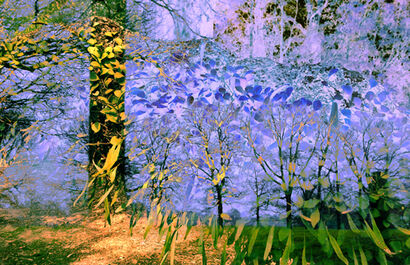
ln 1990, following her first color photography exhibition of this technique, Corrie
was dubbed ‘Queen of the Overlays’. Her signature use of collage and overlay created
a hybrid imagery, often dreamlike or surreal, with echoes of pagan mythologies and
fables. She has remained on this path ever since, both analogue and digital, exhibiting
solo and in many group & online shows.
In 2006, Belle Art was born, a company established to further showcase Corrie’s work.
Belle Art is set to produce a series of picture books, utilising its myriad of themes.
With an enduring passion for photography, Corrie continues to explore the alluring
ambiguity of the human form, the lusciousness of nature and allegorical spaces in the
urban world.
Corrie currently lives on Dharawal Country in the Illawarra, a coastal region of NSW