
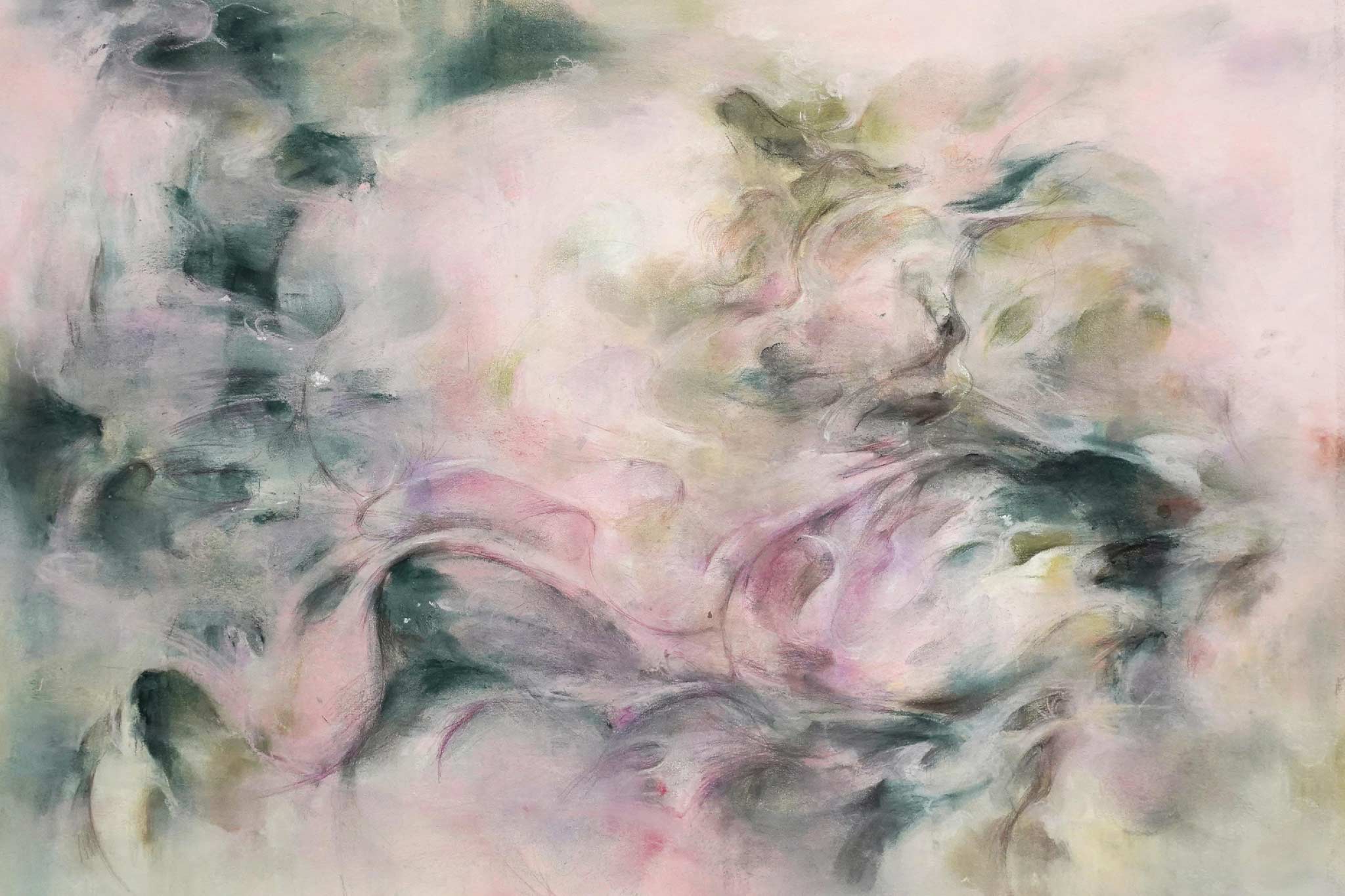
23 Nov Interviewing Yilin Zhang | Finalist of Arte Laguna Prize 2025
Yilin Zhang (b. 1998, China) lives and works between Shanghai, London, and Athens, Georgia. She is currently pursuing a PhD in Art at the
University of Georgia, after receiving her MA from the Royal College of Art and her BA from the China Academy of Art. Centered on painting, her
practice also spans printmaking, installation, performance, and writing. Shaped by her cross-cultural experiences across China, the United
Kingdom, and the United States, her work explores mysticism, trauma, mythology, monstrosity, supernatural phenomena, and science fiction
through a comparative and intuitive lens.
Hello Yilin, welcome to Arte Laguna World interview!
First, congratulations on your selection as a finalist in Arte Laguna Prize 20th edition! Your work “Enchanted” is now currently exhibited in the spaces of Arsenale Nord of Venice, how does that make you feel?
It’s my honor to be selected. I feel that I have a special connection with Venice, as I’ve exhibited my work here before.
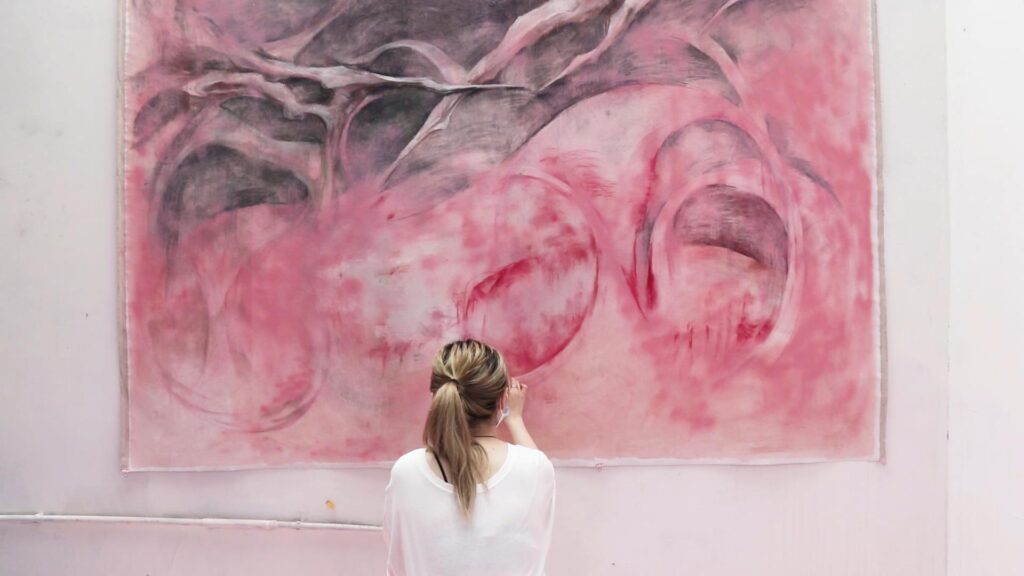
In the description of your works, it is stated that you use “painting, sketching, and immersive installations as my method of […] creating a dystopian environment and reshaping perceptions that transcend communication”. At first glance, your paintings appear very graceful—almost ethereal in their abstraction. What is the key to interpreting them that connects this initial impression to their underlying meaning, which seems to be quite different?
An interesting question. For me, beauty and dreaminess form a complex feeling; at times, beauty and unease become one mixed, interwoven experience. This ethereal quality is the aesthetic I’m drawn to in my work. At the same time, this piece was inspired by science fiction and Gothic novels such as Frankenstein. I’m fascinated by machines and mechanical life in an enchanted state, as if under a spell. But does a “monster” have to be frightening? I think this kind of life can be very beautiful, even surreal. But if we look closer, it can feel uncanny and unsettling.
I also don’t think it matters most whether viewers arrive at my interpretation. A creator shouldn’t try to make the audience see only their intention. What I care about more is what viewers see through my work. So if what they reach is the dreamy, opulent surface, and that visual effect makes them feel something, whether through touch or on an emotional or spiritual level, that is more than enough.
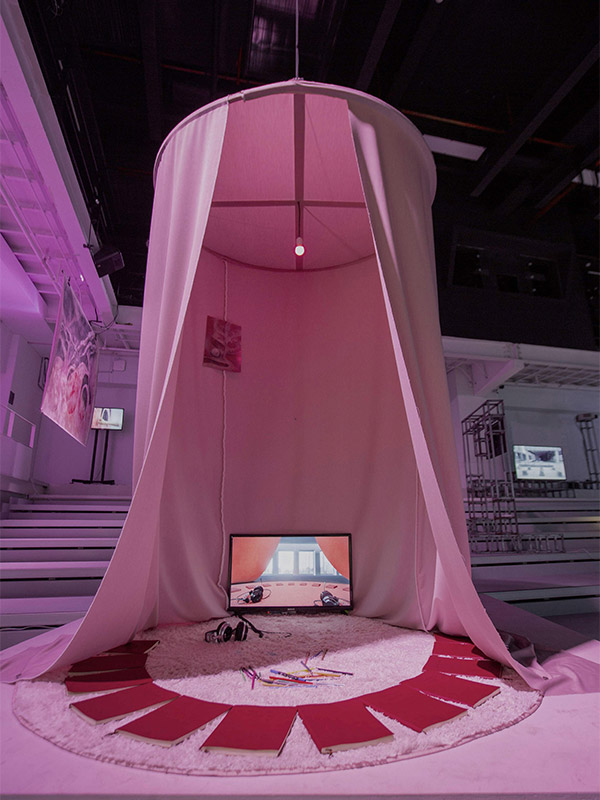
Chiron’s Room, 2022
Installation, video, dimensions variable
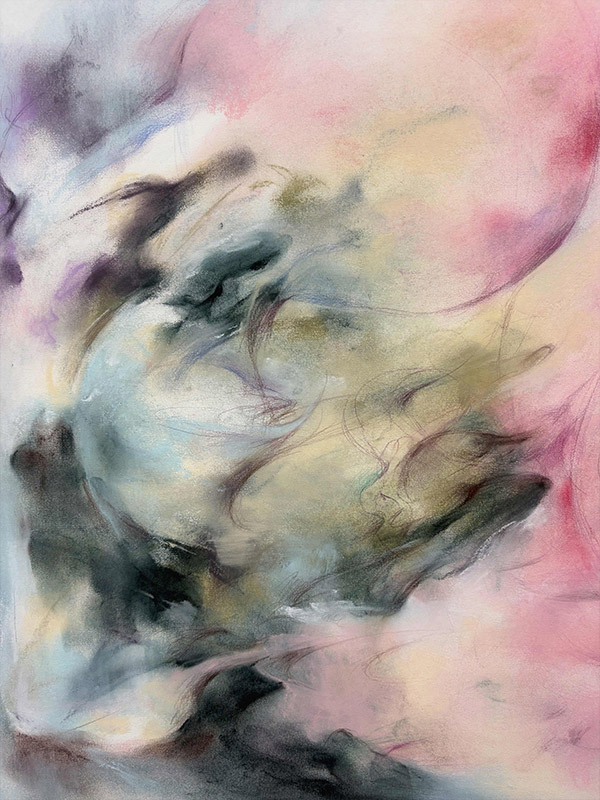
Fairy Child, Wild Rain, 2026
Painting, fiction
At first glance, someone reviewing your portfolio will notice a distinct, personal style. Your work is always presented in an aesthetically composed and pleasing manner, yet it conceals much deeper meanings when one examines the concept you intend to convey to the audience. How would you interpret your own work today?
I don’t think how I explain my work really matters that much. Sometimes I’m not fond of the formalist approach in Western art history, which reads art in a very mechanical way. The one thing I can state clearly is that my work isn’t meant to be decoded, as if a certain color or symbol stood for something. Instead, it uses painting and other media to create a new world. In other words, viewers are invited into this world. The paintings may feel pleasurable, but they may also bring discomfort (if you’ve seen them in person). I think viewers can enter these works with an open mind: the ferns inside might tickle your arm, or an unknown creature might kiss your cheek. Everyone will feel something different.
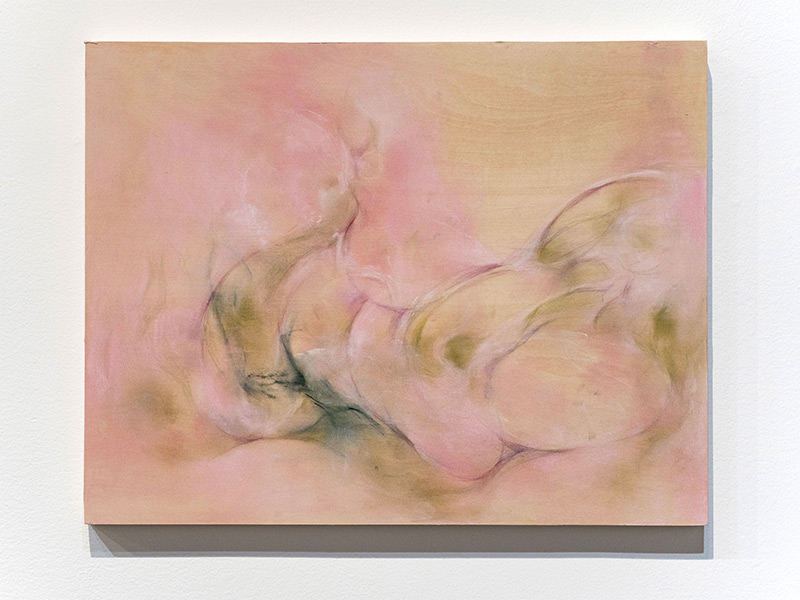
Fairy Child, Wild Rain, 2026
Painting, fiction
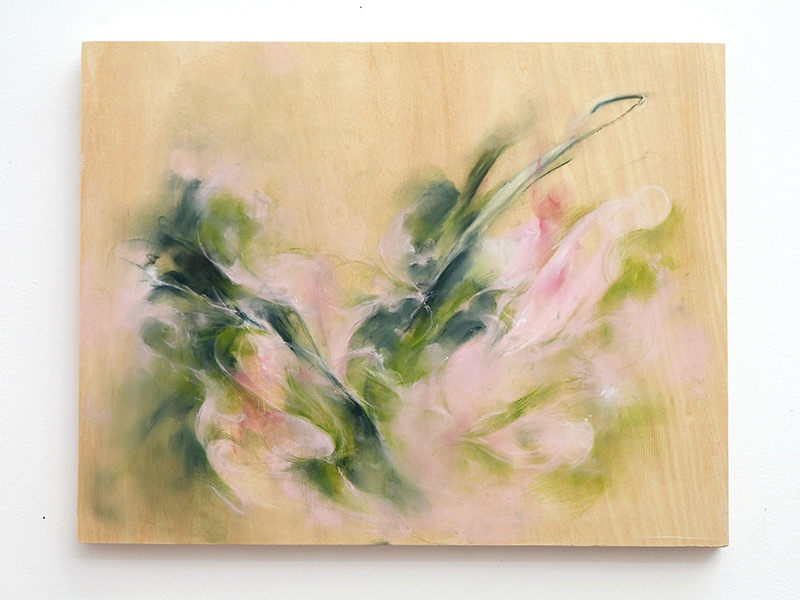
Fairy Child, Wild Rain, 2026
Painting, fiction
The “Enchanted” serie is just one of the many that you have created. Is there another that you believe represents you more, or to which you feel most attached?
I think the series Fairy Child, Wild Rain better represents my newest creative direction. The paintings in this series also began as explorations of soft pastel, acrylic, pencil, and mineral pigments, and in the future it may take on some 3D forms as well. The series is inspired by the entangled relationships between human and non-human life in New Weird fiction and in Ming-Qing ghost and supernatural literature.
I made *Enchanted* while I was studying in the UK. I gave it that name because at the time I was fascinated by alien-like bodies in an enchanted state, as if under a spell. I loved Sun Yuan and Peng Yu’s Can’t Help Myself, for example. To me, that giant mechanical arm looked deeply sad, because for all its terrifying presence, this manufactured “life” could neither control nor change itself. Back then, my sense of violence and bodily movement was relatively direct. That piece was painted in oil combined with oil stick, and it already had a lot of smudging, but my understanding of oil paint’s own material properties was limited at the time.
By the time of Fairy Child, Wild Rain, I feel I had become much more complex, and my understanding of violence had changed. I no longer seemed so obsessed with overt violence. Violence can be a process that looks very gentle; in fact, it is precisely extreme tenderness that produces a kind of violence. So the whole series is about “tender disaster,” a name I coined. The idea of disaster here comes from Maurice Blanchot’s The Writing of the Disaster: désastre (dis-astre) means a fate separated from the stars.
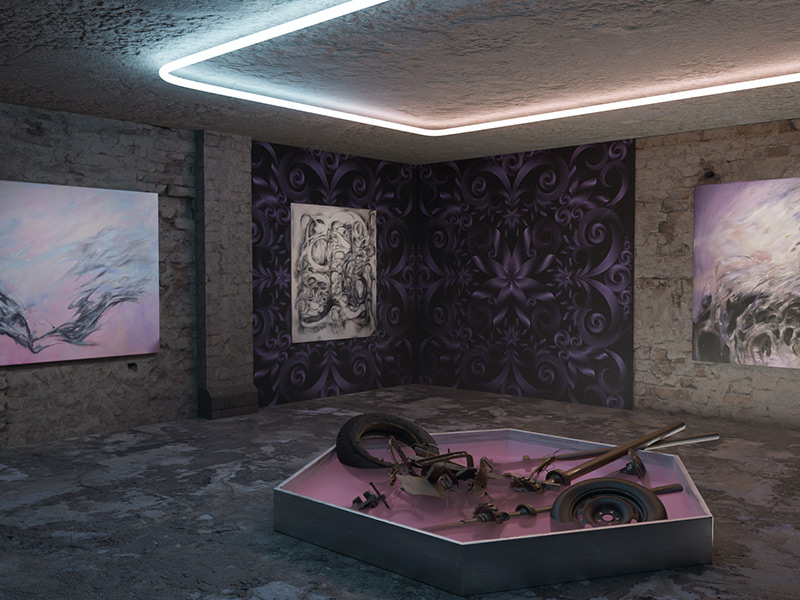
Enchanted, 2023
Painting, drawing, installation
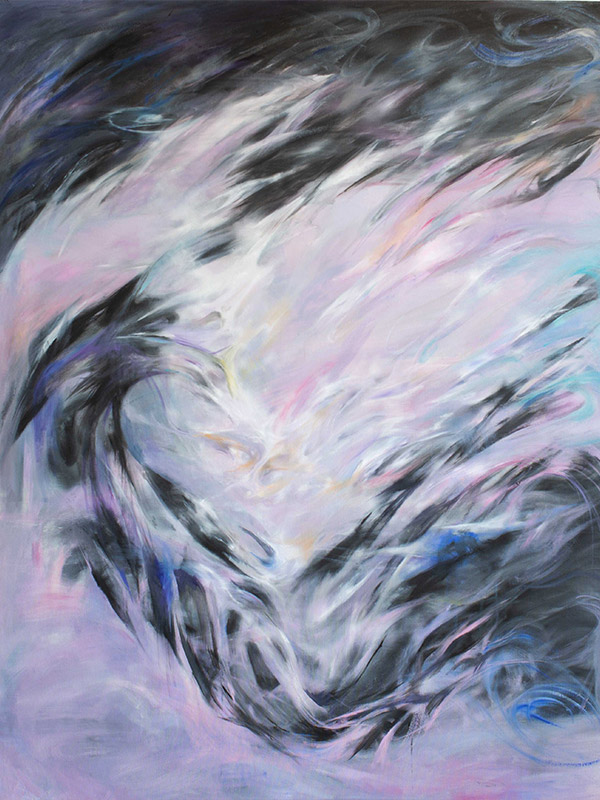
Enchanted, 2023
Oil on canvas
From your online biography, we learn that you have travelled extensively. Do you think that experiencing different cultures has had an impact on your work and your artistic evolution, or have you always had a clear goal in mind from the very beginning—one that has never changed?
Yes, I think cross-cultural experience is very important to me.
Although home and belonging aren’t the main focus of my work, living for long stretches in China, the UK, and the US has shaped the overall character of my work and my long-term thinking, especially my relationship with my origins. I left home at a very young age to study art in Beijing; I was only 15 the first time I rode one of those old green trains. My hometown isn’t a place where art education flourishes, so I always had to go elsewhere to study art: first to Beijing, the capital of China, then to Hangzhou for university. After graduating I went to London to study painting, and now I’m doing my PhD in the US. So it has truly been a rich, nomadic experience.
One of the most obvious experiences: when I was an undergraduate in the Printmaking Department at the China Academy of Art, I longed for Western contemporary art, especially conceptual and installation-based work. That’s why I went to study in the UK. Yet living in the UK and the US for so long sparked a reverse curiosity about my nationality and about Chinese culture. […]
My work usually doesn’t have a clear goal, but it does have certain themes. In this series, for example, I was drawn to Dr. Frankenstein’s monster and to Lilith, figures that are at once terrifying, beautiful, and sacred, and I let them descend onto the canvas.
Finally, do you have some future projects you would like to talk about?
I want to slowly continue with my current Fairy Child series. Unlike before, I’m not exploring different media and creative themes as much anymore. I feel like I’m currently entangled, dealing only with the themes that are important to me at this stage. However, I will be exploring materials and creative language more. Since coming to the US, I’ve taken a painting class for the first time, because I was previously in printmaking and hadn’t taken any painting classes before. I really like my current teacher’s philosophy that painters are alchemists, so they need to spend every day in the lab (studio). To truly explore painting itself, you need to delve deeper rather than expand outwards, so my recent explorations will focus on the materiality of painting language and materials. I really like the texture of some sculptures and textile works, especially soft sculptures, kinetic and mechanical sculptures. I think sculpture, compared to painting, is easier to create a material state that confronts fragility and strength. If I finish my current painting or hit a bottleneck, I might try this direction. Besides this, I’ve started catching up on Chinese art history, literature, and visual culture, and I’m particularly interested in the Song and Ming-Qing dynasties. Spending a long time abroad can lead to confusion about one’s identity, history, and culture. Back in China, I was interested in Western philosophy, especially postmodernism and post-structuralism, but after going abroad, I realized that Western philosophical theories didn’t address my specific questions. Now, I feel increasingly ignorant about China’s own painting and literary traditions. Also, the new series includes written works (mainly novels), so I will continue writing.