
04 May “Voir / 又见”: The Inner Journey of Ding She’s Art in Shanghai
In Shanghai, a city of international cultural exchange, convergence, and integration, amidst the historic architecture of the Bund, the exhibition space of the Space & Gallery Association (SGA) hosts the exhibition “Voir / 又见” by contemporary Chinese artist Ding She (丁设). The exhibition, open from March 20 to May 5, 2026, invites the public to embark on a visual and spiritual journey through the multiple dimensions of perception, experience, and memory. Curated by Wang Yu, the exhibition reflects on the relationship between the visible and the invisible, between reality and interiority, offering visitors an immersive journey that goes beyond simple aesthetic contemplation.
An artist between Eastern tradition and contemporary experimentation
Born in 1972 in Linhai, Zhejiang Province, China, Ding She belongs to a generation of contemporary artists who have successfully engaged in dialogue with Eastern philosophical tradition while embracing visual experimentation with contemporary language. He currently lives and works in Shanghai, one of the most dynamic centers of the Asian art scene.
Throughout his career, the artist has participated in numerous international exhibitions, including shows in Venice, Shanghai, and various museums and biennials dedicated to contemporary art. His artistic practice spans diverse media—painting, installation, and spatial experimentation—and is distinguished by a research that connects the spiritual dimension, visual language, and perception of the contemporary world.
Ding She’s approach is based on a balance between cultural roots and global openness. His poetics combine elements of Eastern philosophy, such as contemplation and the search for the essence of things, with expressive modes typical of international contemporary art. This dialogue between tradition and experimentation becomes the key to understanding the exhibition Voir.
The exhibition “Voir”: a journey in five chapters
The exhibition’s title, Voir—”to see” in French—recalls the primary act of perception. But, from the artist’s perspective, seeing does not simply mean observing: it also means recognizing, understanding, and rediscovering what often remains hidden in the frenzy of contemporary life.
The exhibition unfolds through five conceptual sections, which outline a gradual path from the external world to the interior dimension: observing the phenomenon, the context, the heart, purity, and emptiness.
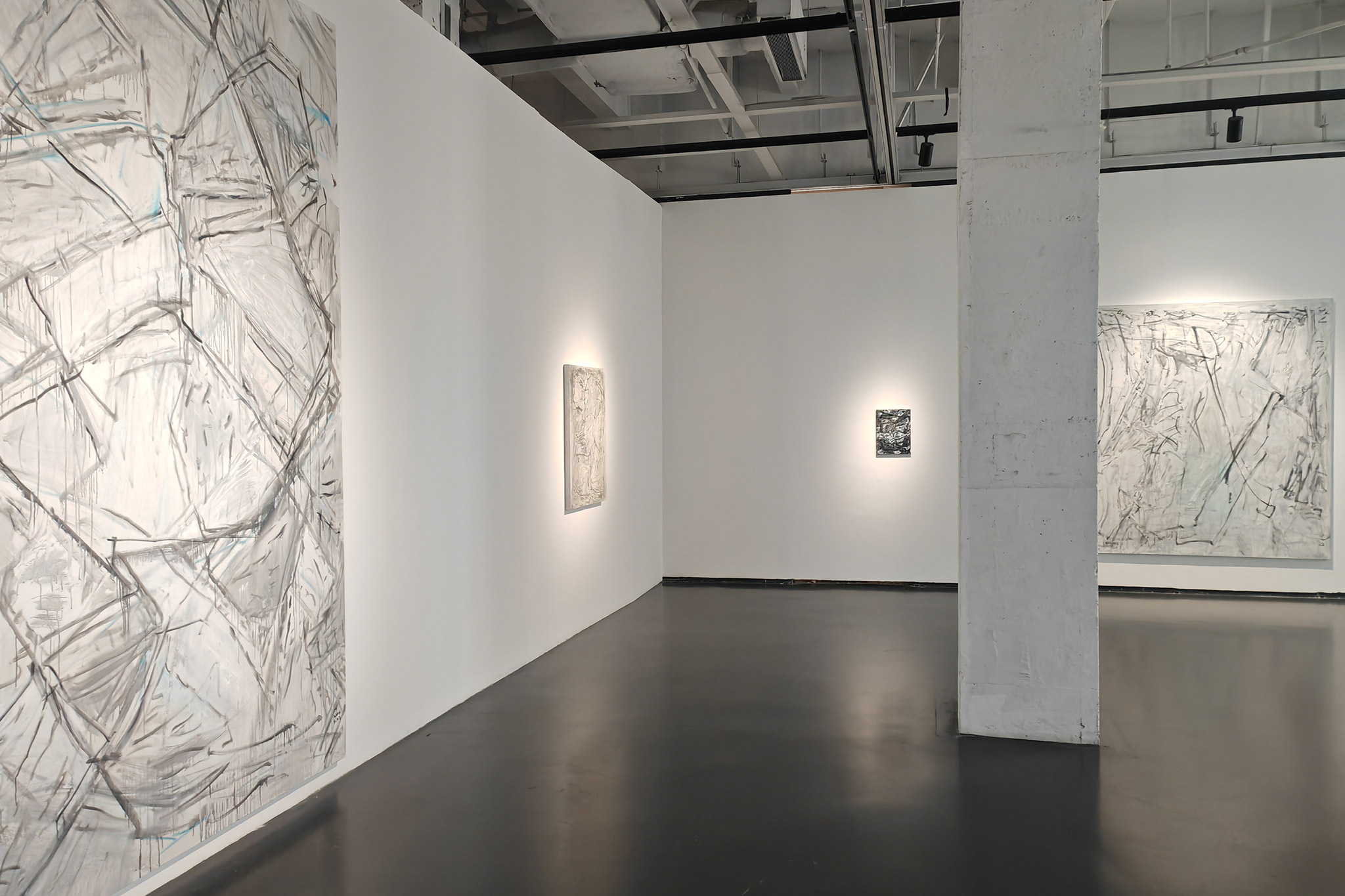
The first chapter, “Observing Phenomena”, invites the public to engage with the surface of reality. The works presented in this section visually translate the complexity of the contemporary world: lines, signs, and compositional structures evoke urban architecture, historical memories, and fragments of everyday reality. Through gestural and layered painting, Ding She constructs a visual language capable of transforming observation into poetic experience.
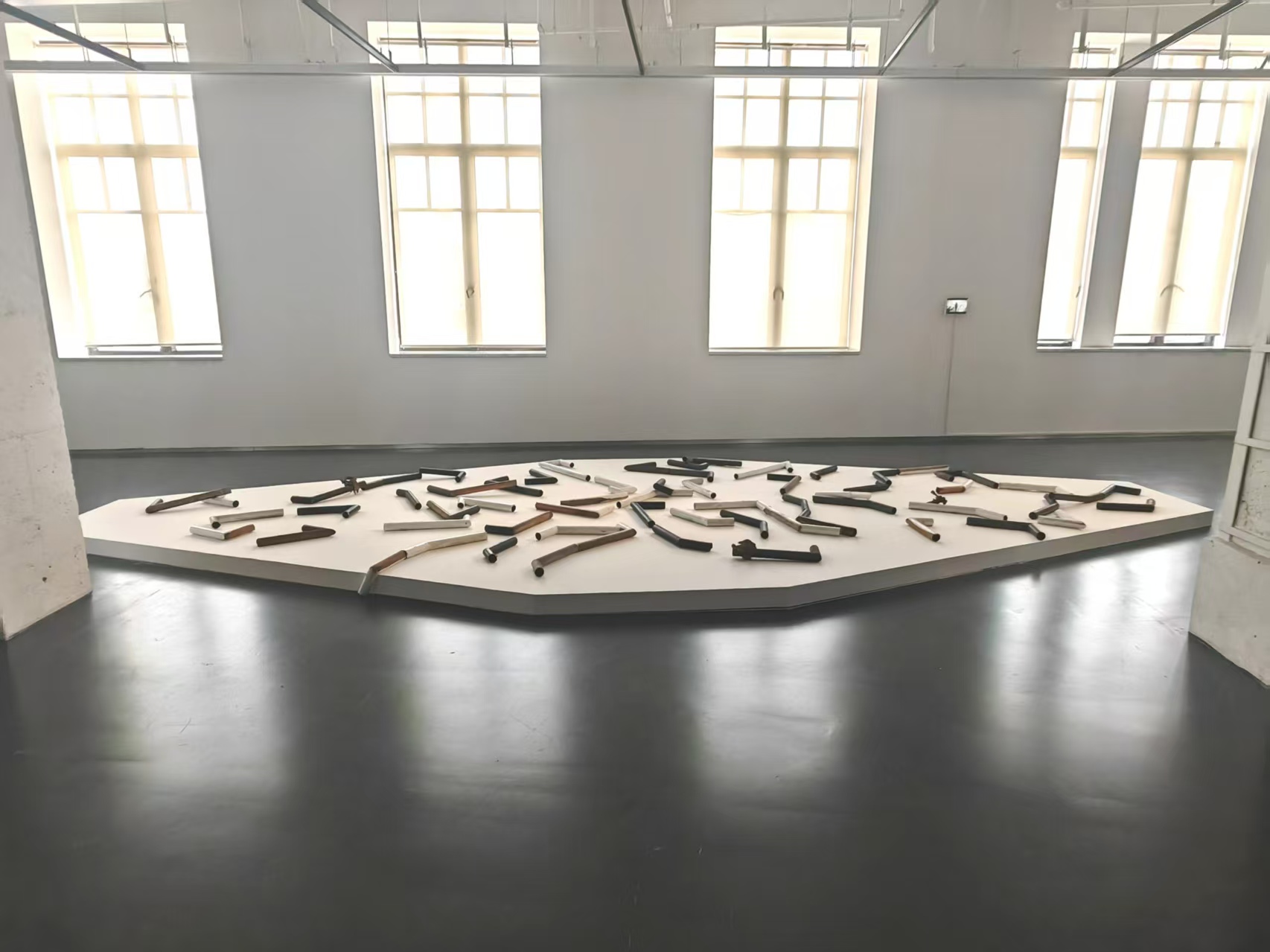
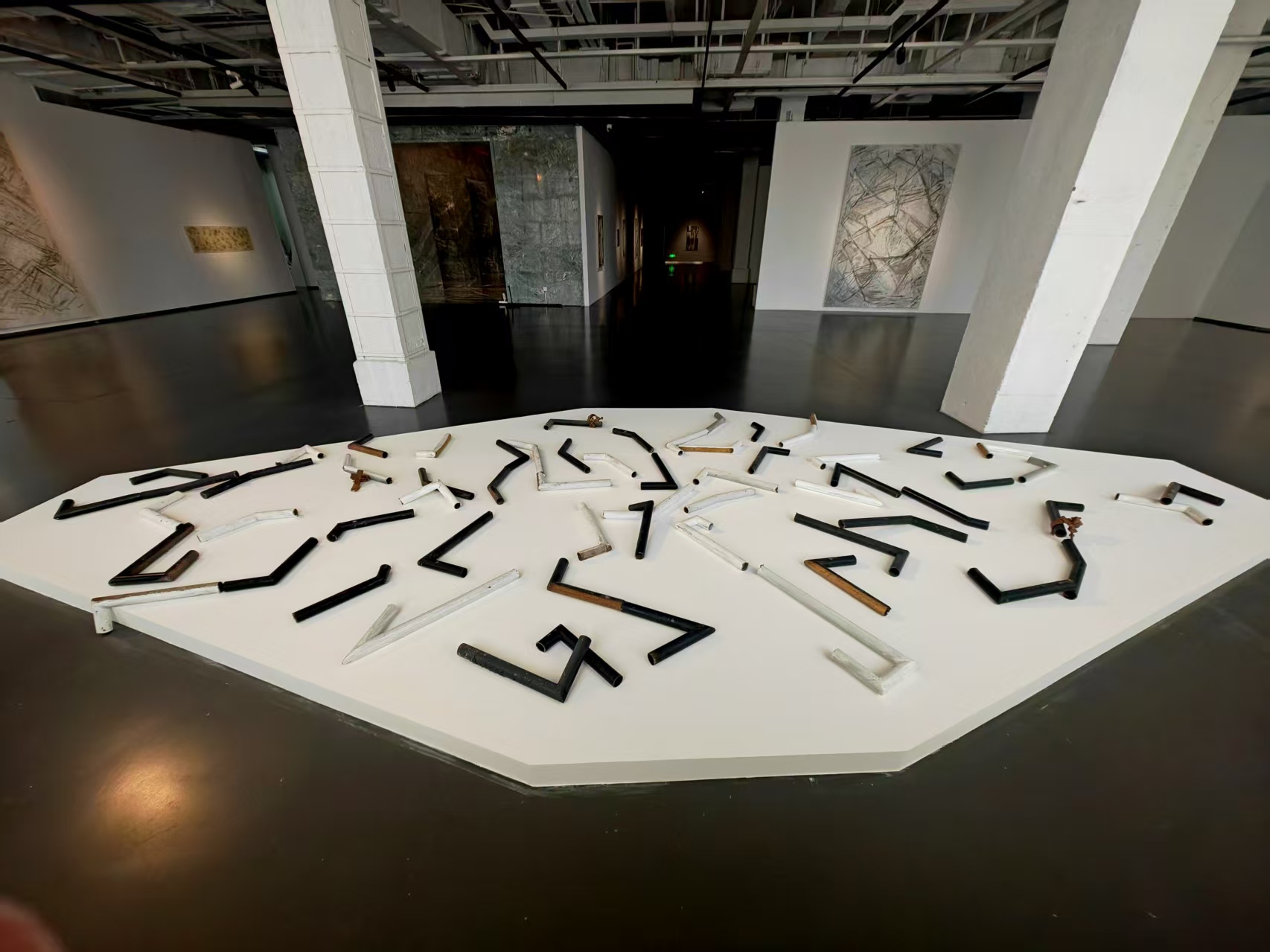
This is followed by “Observing the Context”, where art is no longer merely an image, but a space to be traversed. Here, the works engage with the exhibition space, transforming the gallery into a sensory landscape. Installations and pictorial structures create an immersive environment that invites visitors to physically enter the work, dissolving the boundary between viewer and art space.
The third chapter, “Observing the Heart”, represents the most intimate moment of the exhibition. The focus shifts from the exterior to the interior: the artist delves into the emotional dimension of human experience, bringing to light often-forgotten memories, feelings, and perceptions. It is an invitation to slow down and rediscover a dimension of awareness.
From Purity to Emptiness: An Aesthetic of Subtraction
In the “Observing Purity” section, the visual language becomes more essential. The compositions seem to gradually free themselves of superfluous elements, approaching an aesthetic of subtraction. The pictorial gesture becomes more rarefied, leaving room for silence and contemplation.
This progressive simplification leads to the final chapter, “Observing the Void“, in which the work transcends the material dimension to approach an almost meditative dimension. Here, the artist draws implicit inspiration from Eastern philosophy, where emptiness does not represent absence but potential, a space open to freedom and transformation.
The exhibition thus suggests a movement from the visible to the invisible: from the observation of reality to the discovery of a deeper dimension of experience.
A visual language between writing and painting
One of the most fascinating aspects of Ding She’s work is the way she integrates the concept of “writing” into contemporary painting. The lines and signs that crisscross her canvases often evoke abstract calligraphy, a kind of visual language that not only represents the world but also interprets it.
Through processes of overlapping, interweaving, and dissolving forms, the artist constructs compositions in which the pictorial gesture becomes an almost meditative act. The surface of the canvas appears as a dynamic field in which signs and structures emerge, transform, and disappear, suggesting a continuous metamorphosis of the image.
This processual dimension makes each work a kind of mental landscape: a space in which time, memory, and experience intertwine.
The experience of the exhibition
Visiting Voir means embarking on a journey through different levels of perception. The exhibition leads the public on a progressive path that stimulates not only the visual, but also reflection and emotional sensitivity.
The exhibition space of SGA Art – Hushen Art Museum, located on the third floor of the Three on the Bund building in Shanghai, helps create a dialogue between contemporary art and the urban context. The gallery, open since 2004, has hosted hundreds of exhibitions and collaborations with international artists, fostering an ongoing dialogue between art, design, fashion, and technology.
In this context, Ding She’s exhibition fits perfectly with the institution’s mission: to build bridges between different artistic languages and disciplines, fostering new forms of cultural exchange.
Finding your gaze again
The title “又见 / Voir” can also be translated as “seeing again.” It’s not simply about observing something for the second time, but about rediscovering it with a different perspective.
In today’s world, dominated by rapid and superficial images, Ding She invites us to rediscover a slower and deeper dimension of perception. Her works suggest that the act of seeing can become a transformative experience: a moment in which the external and internal worlds meet.
The exhibition thus becomes an invitation to every visitor: to traverse the space of art to rediscover something of themselves.
Laura Gallon
Fondatrice Associazione Culturale MoCA Italia
(Modern and Contemporary Art of Italy)