We are faced here with
a threshold-work — not a piece that simply represents, but one that questions
the very act of appearance. What Ariane R.’s painting offers is not objects,
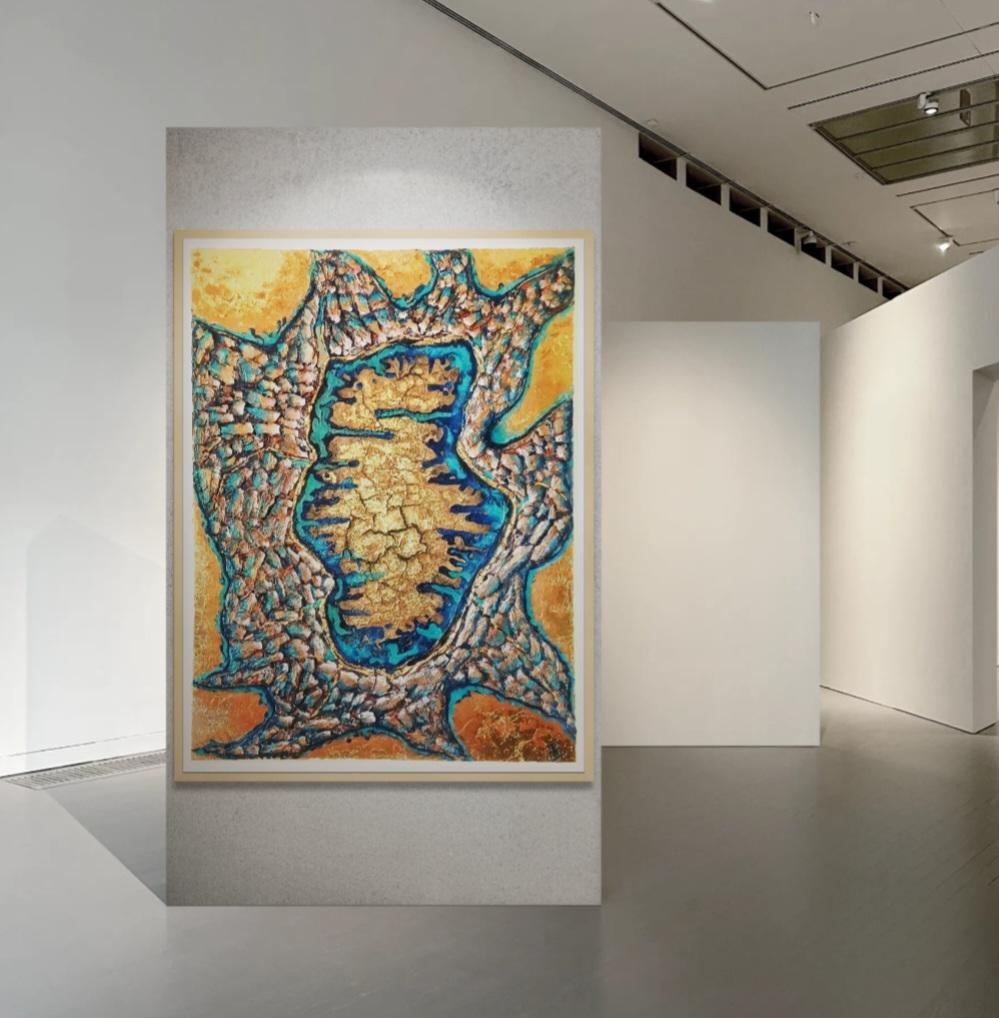
nor even places — but passages. The Tree of Rebirth is one of them: a rugged,
fractured crossing, where gold is not opulence, but illuminated wound. It does
not represent — it resurfaces. It rises like a form torn from silence, a
vibrating core of matter, an ancient cry fossilised in light.
At first, the painting appears
mineral, but it gradually reveals its maternal nature: a stratum of soul
surfacing into the visible world. In its texture, in its cracks, lies a
telluric memory — not a conscious one, but one incarnated, seeping from its fissures
like forgotten sap, a wounded light returned from the abyss.
But above all, the painting summons
a centre — radiant, inhabited by absence, by gold, by silence. A centre that
does not impose itself, but keeps vigil. That golden heart, that vibrant knot,
that cracked core of fire is no answer — it is proof. Proof that there was
burning, fracture, passage. And that from that passage was born a form — not
appeasement, but a rebirth torn from the very harshness of matter.
One might speak of a profaned icon,
of a reliquary fractured by light, of a map of an inner world. That gold, once
clothing saints and angels, collapses here into the wound — no longer a halo,
but a trace. Yet we must go further. This painting is an ontology of being
shaped in form. A sensation of fissured being made visible in the material.
Ariane R. offers, as testimony, that truth we learn only through pain: the
surface must be broken for light to enter. And as Paul Valéry once sensed,
“what is most profound in man is the skin.” The centre can only radiate after
it has been cracked open.
In the language of archetypes — the
speech of the ancients — the work reenacts the myth of the World Tree, the axis
mundi, that vertical junction through which forces, vertigo, and revelation
pass. This transmuted trunk, still upright after collapse, was once a pillar of
chaos, then a relic of a fallen sky — a fragment of verticality kept by the
earth. This tree is not intact. It has been ploughed, shaken, but it stands
still.
What moves us in this painting is
not what it shows — but that it persists. That it still breathes, despite the
fracture. That it listens to the void, and from this void rises a light. And
this light is not decorative — it is metaphysical. It is the sensible form of
an invisible struggle. Can one paint the threshold between silence and memory?
Can one make a wound visible without betraying it? Can one transform a painting
into a passage-organ, a beating heart between the inner and the outer world?
Ariane R. achieves this without emphasis, without noise, but with rare
intensity — for she does not invent forms, she exhumes them from her own
silence. The Tree of Rebirth is no motif. It is a silent answer to chaos. A
sacred resurgence. A form conceived in matter, not in discourse. A profound
call to recover the vibrating core of our own verticality.
For to be reborn is precisely this:
not to return to the same — but to pass through. And perhaps, as Gaston
Bachelard wrote, we must understand that “a truly deep life is a perpetual
rebirth” — not the erasure of what was, but its patient transmutation, at the
very heart of the being that keeps vigil.
___