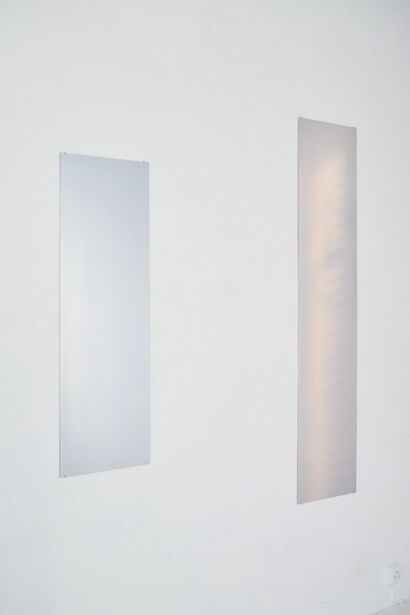
In front of these sculptures, our bodies measure themselves against forms that, by imitating the materiality of rock, evoke fragments of a forgotten world. Covered in photochromic pigments, the sculptures live to the rhythm of natural light. As the sun’s rays pass through them, their surfaces come to life and shift in colour, oscillating between light and dark grey. As the light intensifies or fades, the colour evolves and eventually returns to its original state once the light has disappeared. In this way, the sculptures slowly metamorphose, embedding a delicate temporality within their very material. The sun transforms them, but also drains them of their physical properties: as time passes, the pigments fade away.
" Entre-deux or the Hidden Side of Things
personal exhibition — standard/deluxe,
Lausanne, SWITZERLAND — 2024
A drop of water that escapes from a cracked glass roof and fills the pond on the ground (Flot-fuyant, Salle Crosnier, Geneva, 2019), a curtain of concrete beads that has to be crossed as if entering a house (Tamis misat, Galerie A. Romy, Geneva, 2021), salt that crystallizes on canvas (Copie non conforme, Circuit, Lausanne, 2021), photochromic pigments that change color with the light (Blurring time, Kunstkaten, Winterthur, 2023) or hammered stainless steel mirrors that reflect the surrounding trees (Variations, public sculpture, Lancy, 2023). Each of Pauline Cordier’s works is designed to fit in with the site in which it is installed, down to the smallest detail. They point to architectural details, functionalities, or histories. They echo or extend them. But they also raise questions. What happens when time passes? What are the shapes temporalities can take? How can we give substance to hidden things?
With Entre-deux, Pauline Cordier doesn’t stray from her own rules. She tells the story of the link to a place. The artist takes as her starting point both the history of Lausanne, with its topography shaped by soft stone and waterways, and the architecture of the exhibition space. The latter conceals the city’s rock and shelters a river. Standard/deluxe nestles between hollows and hills, maintaining a secret relationship with the natural elements that surround it. To reveal this intimate relationship, to show invisible forms and bear witness to obsolete functions, the artist sets up a gradual unveiling. First, with fluorescent-yellow ventilation grilles. By scattering them around the walls, Pauline Cordier reproduces and duplicates those already present, which allow the rock to breathe. And with a silver manhole cover. Moulded onto existing one and placed on the surface of a new white floor recreated by the artist, it suggests the flow of water and evokes a past presence. One is almost reminded that matter is alive and moving. Finally, with a certain frontality, the artist places three translucent forms in the centre of the space. Our bodies are confronted to these objects which, by imitating the materiality of rock, give us a glimpse of what we never knew existed. Or that we’ve simply forgotten and left behind. The appearance of the sculptures, covered in photochromic pigments, is ever changing: the light entering through the bay window causes them to oscillate from light to dark grey. The sun transforms them yet empties them of their physical properties: the more time passes, the more the pigments die.
What Pauline Cordier conjures up in her sculptures are thus fragments of multiple temporalities. She suggests what remains and what has happened before. She materializes impalpable elements. She sculpts time and invites us to confront it with her. She points out the hidden side of things.
Eleonora Del Duca"