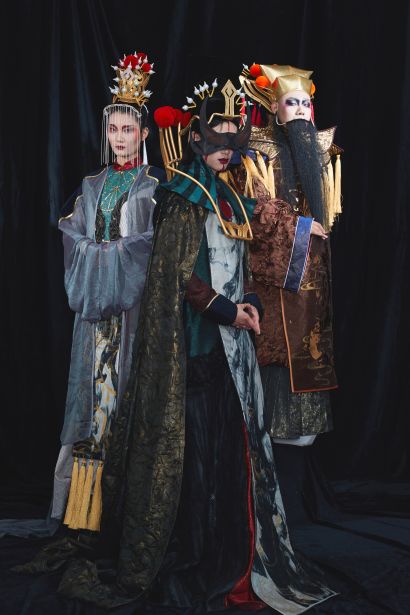
Diweilong Shi is a visual artist and wearable installation designer whose work explores the reconfiguration and fusion of cultural identities through material and form. With academic training in Chinese operatic costume (China Academy of Opera, 2020) and a Master's degree...
Read MoreDiweilong Shi is a visual artist and wearable installation designer whose work explores the reconfiguration and fusion of cultural identities through material and form. With academic training in Chinese operatic costume (China Academy of Opera, 2020) and a Master's degree from Central Saint Martins, University of the Arts London (2023), Shi’s practice bridges traditional theatrical craftsmanship and contemporary visual languages.
Rooted in cross-cultural research, his wearable installations are not merely garments, but sculptural constructs that reinterpret symbolic systems across Chinese and Western traditions. Drawing on references from Chinese opera, medieval European dress, classical architecture, and literary archetypes, Shi creates large-scale wearable forms that function as mobile cultural texts—structures that speak through surface, pattern, and silhouette rather than through narrative.
In 2023, Diweilong led an artist collective to develop a Francis Bacon–inspired wearable piece, later featured in the performance When You Are Looking at Me, commissioned by Central Saint Martins. His 2024 work Miracle, exhibited at the Louvre’s “ROTOR” Contemporary Art Exhibition, was widely praised for its conceptual clarity and tactile resonance. In the same year, his installation reimagining Macbeth through the lens of Chinese Peking Opera was showcased at the Milan International Art Week. The piece was shortlisted for the Medusa Art Award, supported by the Livorno City Government, the Trossi-Uberti Art Foundation, and the Italian National Academy of Fine Arts, and featured in a 2025 special issue of Artist Talk magazine.
Diweilong’s work transcends costume and sculpture, positioning wearable forms as mediums of cultural inquiry and reinterpretation. His practice proposes wearable art as a site where disparate traditions can be layered, abstracted, and transformed—challenging the boundaries of heritage, authorship, and visual meaning.