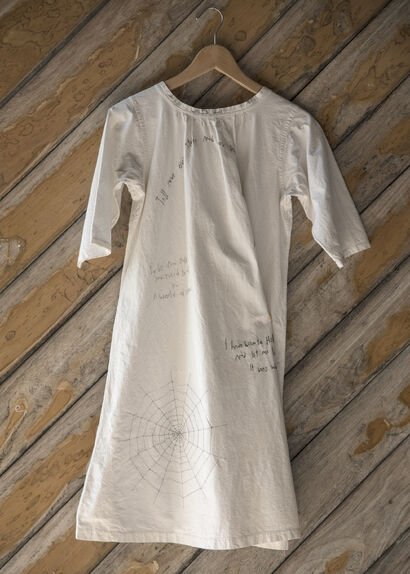
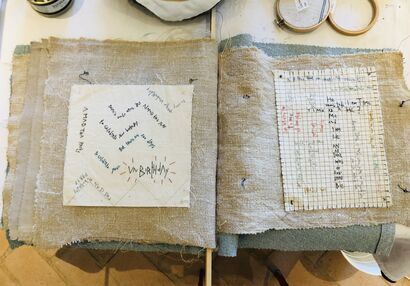
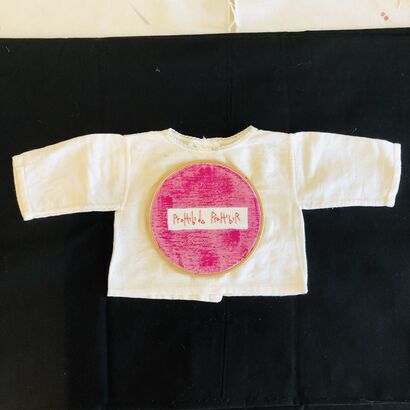
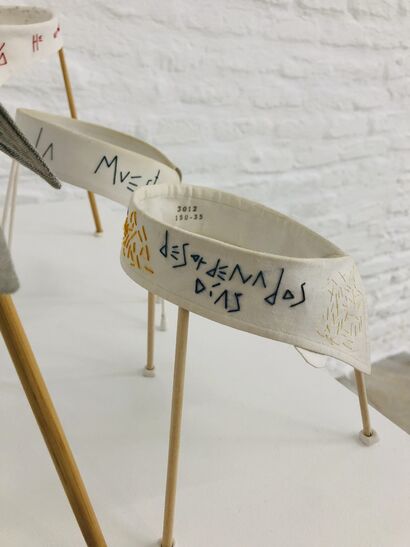
Ana S. Valderrábanos’ artistic practice focuses on textile art, although it spans beyond this
discipline. Stemming from the belief that the idea is at the core of artistic creation, her
approach endorses total freedom in the choice of materials. Fabrics and threads act as a
substitute for paint in an offering she defines as “painting and drawing with threads.”
Cognizant of the historical significance of textile art and its connection to feminism and
social contexts, her work interprets this tradition from a contemporary perspective,
exploring ontological and metalinguistic dimensions. She deliberately distances herself
from the demands of traditional technical perfection to embrace a conceptual and
approachable aesthetic, where the back sides of the pieces, with their visible
imperfections, form an integral part of the narrative. Front and back are not opposites but
rather complementary elements with their own identities.
For Valderrábanos, the creative process is a hedonistic act, free from the “perfectionism”
of classical weaving and embroidering. The work, once completed, belongs to the
audience; the process is the artist’s gift.
Her work functions as a pictorial diary that addresses topics such as mental health, self-
awareness, social overexposure, and the dynamics of daily life. These themes are
developed with irony, humor, and philosophical reflection, connecting the transcendent
with the mundane. Her visual language is enriched with symbolism, poetry, metaphors,
and captivating peculiarity.
The relationship between craftsmanship and art is central to her practice, the thin and
confusing line that separates them, not as opposites but as allied languages, engaged in a
dialogue, that mutually enrich one another. Her work values “metis”, the practical
intelligence that guides the expert in the art of weaving, combining technical skill with
creative intuition. This ancestral knowledge is recontextualized in her work to explore the
boundaries between art and craft.
The use of materials and textiles with a history adds a unique narrative component, where
each medium acts as a hieroglyph that redefines its purpose. The use of the color is linked
to the artisanal process of dyeing the fabrics, an act that provides a tangible authenticity to
each piece. She works with stark contrasts and flat colors, which gives the compositions a
direct visual intensity and reinforces the connection between manual work and the visual
presence of it, creating a sense of immediacy and honesty on each surface. In a certain
way, it evokes the essence of votive offerings: very primitive graphic expressions in their
form but charged with emotion and symbolism.
This vision resonates with the words of Mark Rothko:
“I trust that there is a certain sensitive audience who does not expect to understand
anything; if it has spirit and need, will make good use of the work.”
Ana Valderrábanos’ work challenges and expands traditional notions of art