Gabriel Carucci is a visual artist whose practice questions the notion of home, identity and memory. After having spent most of his childhood years between Italy and Ethiopia, he then moves to London to complete his studies undertaking a BA...
Read MoreGabriel
Carucci is a visual artist whose practice questions the notion of home,
identity and memory. After having spent most of his childhood years between
Italy and Ethiopia, he then moves to London to complete his studies undertaking
a BA at City and Guilds of London Art School and an MA at the Royal College of
Art, graduating in 2018. He currently resides and works in Perugia while
participating in both solo and group exhibitions both nationally and abroad.
The artist
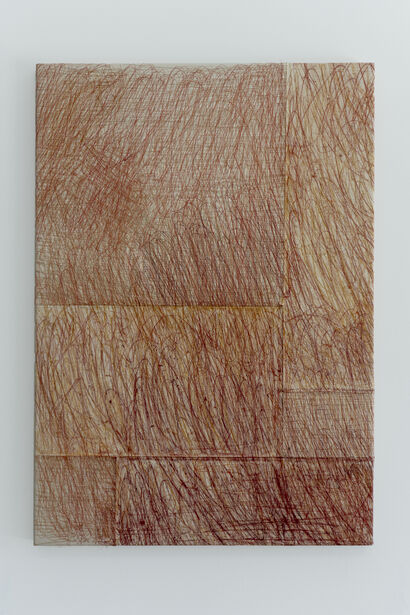
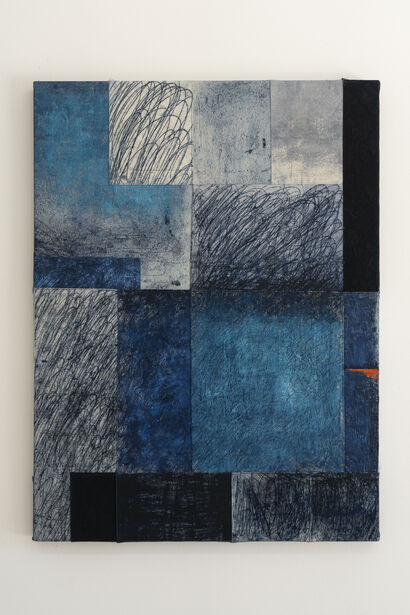
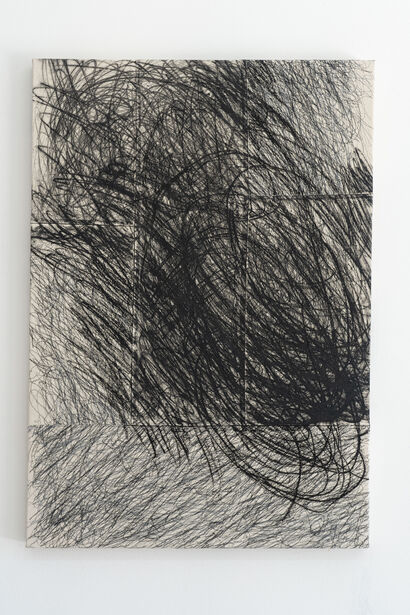
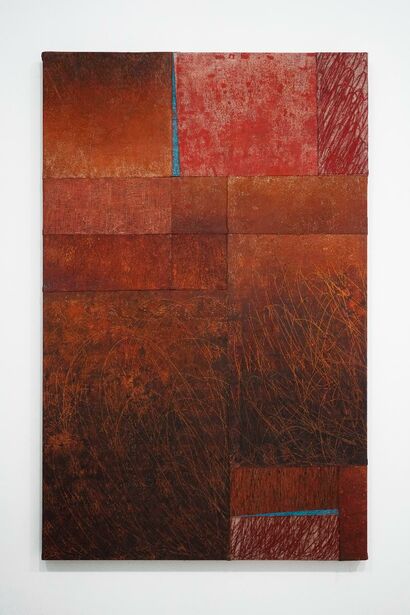
aims at achieving an interrelation between disparate portions of canvas, each
of which reflecting a particular memory; these are then machine-stitched
together as one coherent body. Automatism dominates the artist’s process: there
is no figurative representation of what constitutes each individual mnemonic
trace; rather, it is the essence, transfigured into a sign through a gestural
and instinctive practice guided by the unconscious. The threads intertwine,
bind, and permeate the entire surface, connecting fragmented memories to the
concept that unites them all: home. The surface of the paintings appears
stratified, whereby each layer reflects past experiences, ideas and thoughts
that enable the artist to better understand the question: “what is home?”, from
the perspective of someone that is used to calling home everywhere and nowhere
at the same time.
The attention placed on the materials employed
in the execution of each piece is tangible and an essential component of the
artist’s visual language. The selection and manipulation of the techniques and
materials used mirrors the artist’s struggle in confronting the flatness and
limitations of the physical surface of paintings. A struggle further reflected
by the constant need for experimentation, whose aim is to build a visual
language that most eloquently gives shape to abstract thoughts.