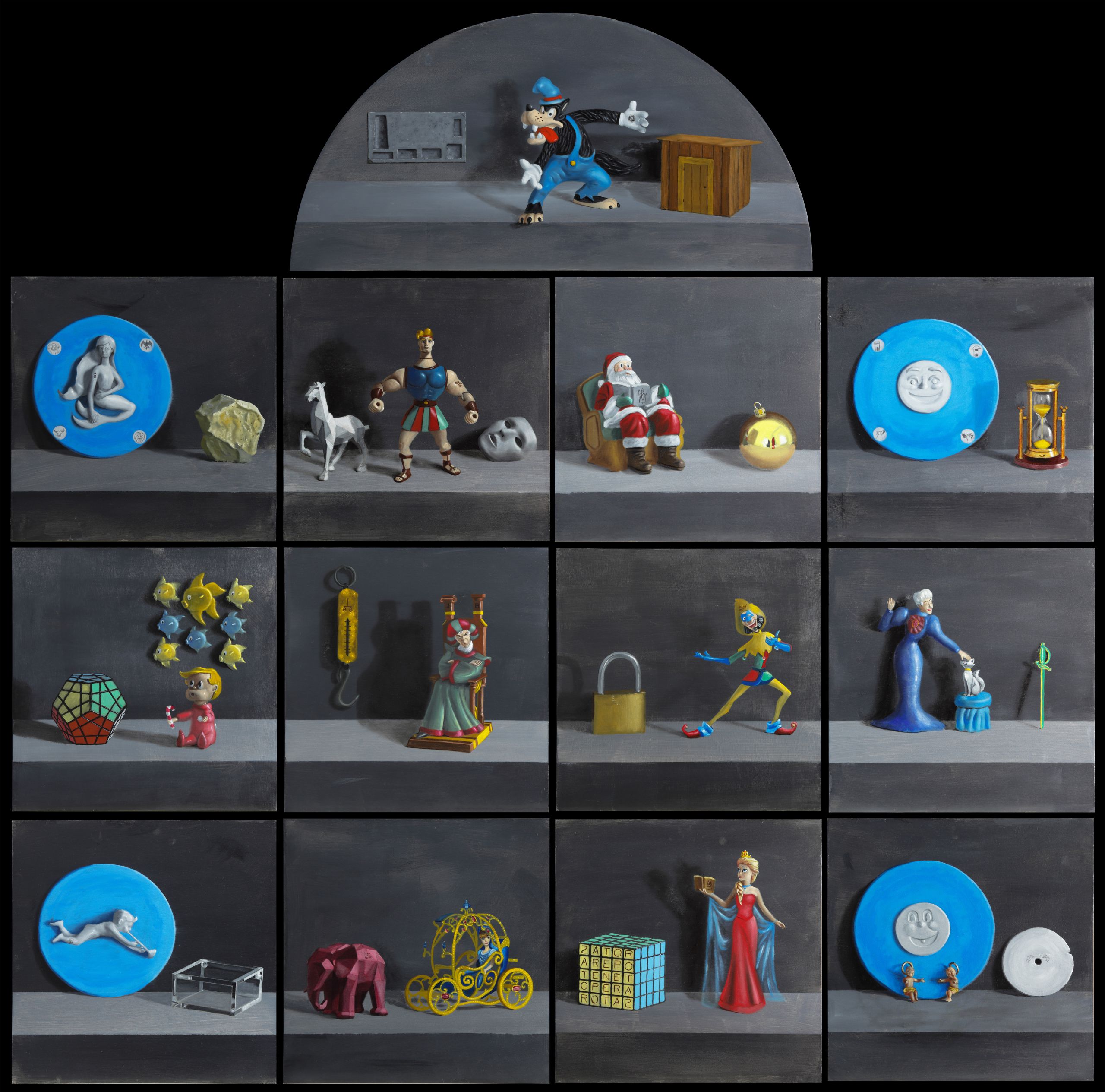
The polyptych of the hypocrisies is inspired by the façàde of a church in Ascoli Piceno, called the "Bible of the poor" because it was once completely frescoed with the stories of the Saints. It is is an oil on poplar wood, and consists in 12 panels 40x40 cm, plus a lunette 80x40 cm.
The artwork offers an experience of augmented reality through the Artivive application: each panel of the painting will reveal its hidden symbologies. You can also experience the augmented reality also in front of the monitor of your computer. Try it! According to my needs, Artivive has programmed the application to adapt to the language of the smartphones: currently it is available in French, Italian and, for any other language, English.
In each scene there is a Lauretan tattoo, because in ancient times the pilgrims who visited the holy house of Loreto got tattoos of Christian symbols as a sign of devotion.
Every tattoo, symbol and geometric shape is linked to a tarot card.
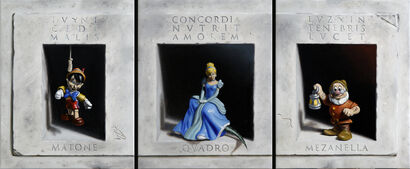
In the wolf panel, the hut represents "The House of God". The reproduction of the Ascoli Piceno stone refers to the "Triptych of ambiguity".
The mermaid is “The World”; she is located in the center of a panel inspired by the Della Robbia’s terracottas, with the symbols of the Evangelists around it.
"The Lover" is, like the Hercules described by Annibale Carracci, in doubt whether to choose pleasure or virtue.
While Santa Claus / Hierophant blesses from an armchair, in “The Moon” panel the 2 dogs and the hourglass remind us that time passes relentlessly, as described by Jacopo del Sellaio in "The Triumph of Time".
In “The Stars” panel, they can be found both as a fish, and as a pentacle inside the dodecahèdron.
The judge / executioner sits on a throne that culminates with a Doric and an Ionic column, as in the card of “The Justice”.
The padlock refers to “The Fool” of the Visconti-Sforza tarots; Giotto painted a similar figure as a representation of the "Stultitia", who cannot speak because the mouth is closed by an object.
The sword is one of the symbols of “The Strength”; here, however, the cat takes the place of the lion.
The Angel panel is the representation of “The Judgment”; the transparent container evokes the Sepulcher of the risen Christ.
As Pliny the Elder writes in his Naturalis Historia, the elephant can live up to three hundred years; a considerable period of time, which is what Fame, that is “The Chariot”, aims for.
The cube represents the throne of “The High Priestess”. The riddle of the Sator is an ancient pàlindrome phrase, magic or superstitious words used in ancient times to ward off evil spirits.
Finally, in “The Sun” panel it is also present in the form of hieroglyph.