On the occasion of the
remodelling of the public space on the hill d'en Corts (Barcelona), the
technicians of the Parc de la Serra de Collserola requested an artistic
proposal to place a dry stone land art installation on an esplanade dedicated
to rest and observation.
1. Context
Until the first half of
the 20th century, the Collserola mountain range maintained the agricultural and
pre-industrial activities that had characterised it for centuries. Today, the
existence of walls, vineyard huts, wells, dry stone corrals, cattle tracks,
farmhouses, lime kilns and tile kilns... all over the mountain range are proof
of the secular human occupation. The traditional dry stone construction
technique has shaped many and varied infrastructures that can be defined
according to their functionality and use: delimitation, stockpiling,
delimitation, habitation, circulation, handicraft industry? In this sense, RA
implicitly carries the cultural tradition that uses stone to build the
infrastructures necessary for subsistence, living and spirituality.
2. Justification
The maximum height of
the Collserola mountain range does not exceed the 516 m of Tibidabo, only seven
of the 39 hills that make up this mountain range exceed 400 m in altitude. In
general, hills have been used by mankind to protect life against floods or as a
defence against possible attacks by animals or people. For some cultures, hills
also had a symbolic, religious or funerary connotation. Thus, hills have
historically been symbolic, strategic and protective places. Today they retain
their attractiveness and the interest to visit them. Reaching a hill becomes a
landmark, a moment of meditation and a window to observe the landscape and the
cosmos. In this sense, the height and the location of the hill d'en Corts in
front of the plain of Barcelona, allows us to identify places related to
historical events, natural elements and geographical features. It also helps us
to be aware of the earth and the cosmos as a landscape. Since the first
Neolithic populations, mankind has venerated the sun and the moon, turning them
into symbols of life and thought. American, African, Egyptian, Mesopotamian,
Greco-Latin, Hindu, Celtic, Baltic, Japanese mythologies have turned them into
deities and represent them in different forms, some in the shape of a disc,
such as the Egyptian Ra gods, Inti, Inca, Assur, Assyrian, the circular temple
of Stonehegen...
3. Concept
Ra is conceptualised in
accordance with the location and morphology of the esplanade of the d'en Corts
hill and in keeping with the geography, geology and landscape that make up this
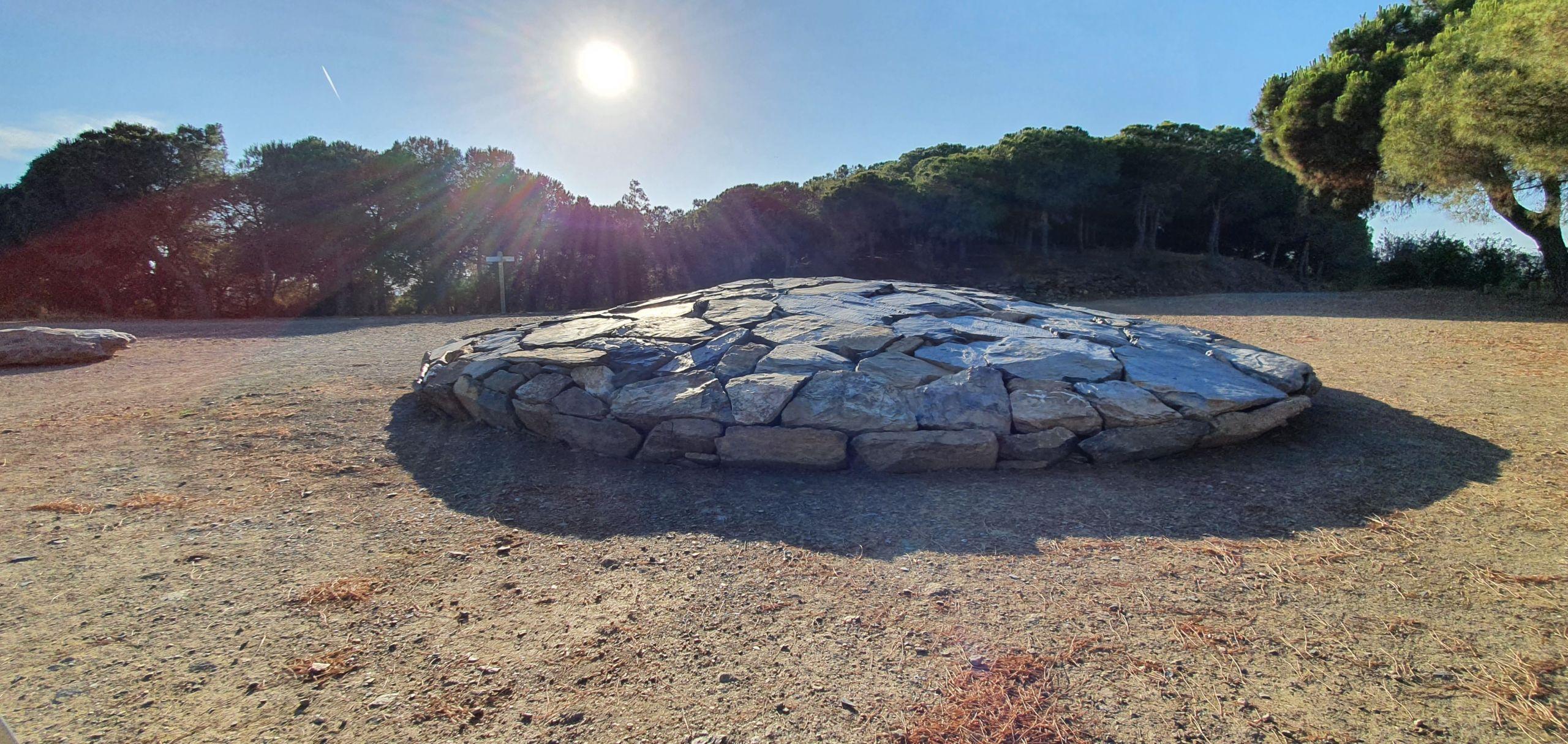
part of the Collserola mountain range. The oval shape suggests the solar and
lunar discs and invites us to think about time and life. The d'en Corts hill is
part of the installation in that it is the scene of the sun's journey from
sunrise to sunset, and is also an ideal place to contemplate the movement of
the moon. Both stars show time as the unattainable fact that human wisdom,
through mythology, has assumed and represented for millennia. They show the
immensity of nature and the smallness of human beings in the face of the
cosmos. Ra aims to surprise with a geometric form used for millennia to
represent the sun and the moon as that which is intangible, unknown and
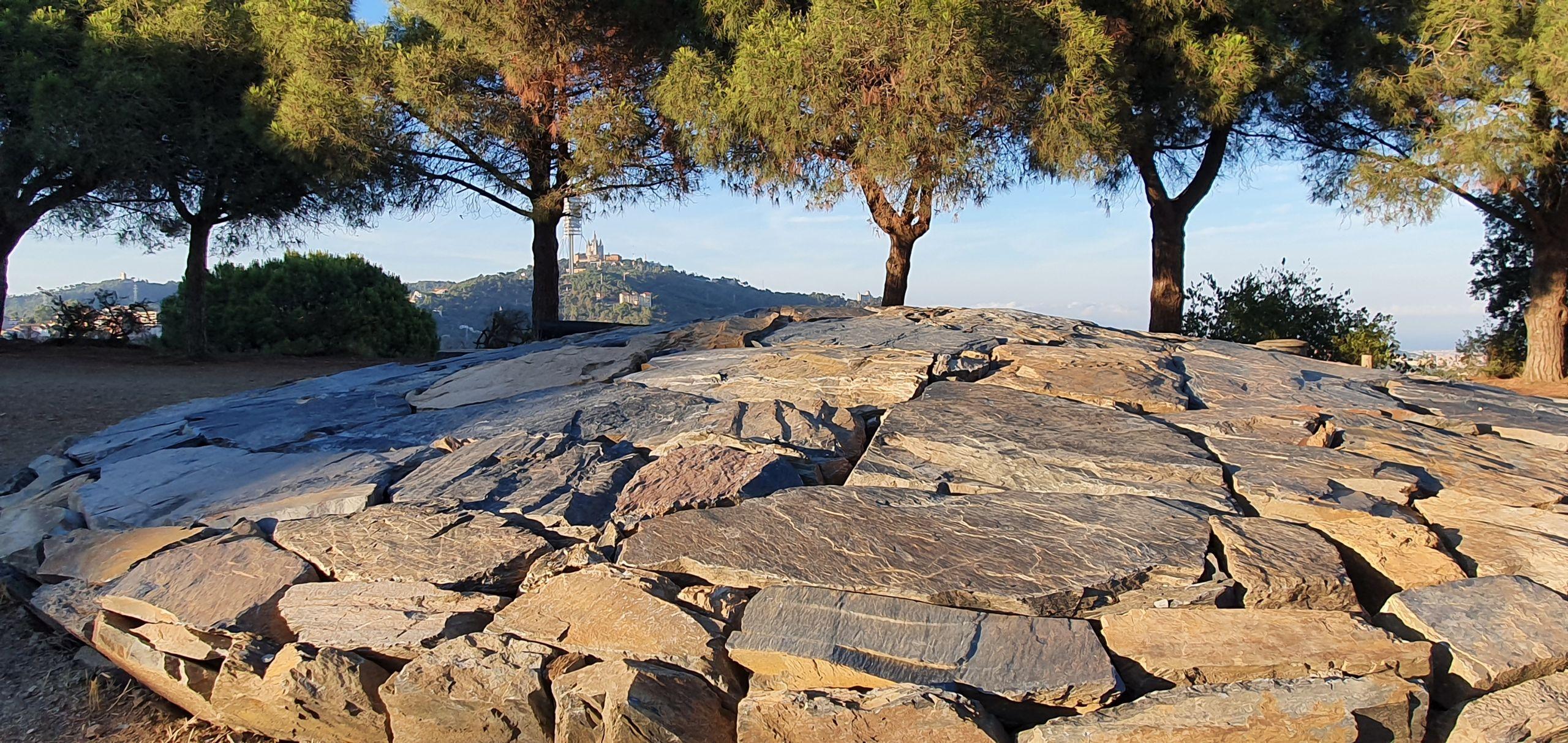
inaccessible. On the other hand, the slates that make up Ra represent the main
geology of the sierra. The morphology of the slate provides a smooth surface
that adds mystery, brightness and colour to the installation. The location of
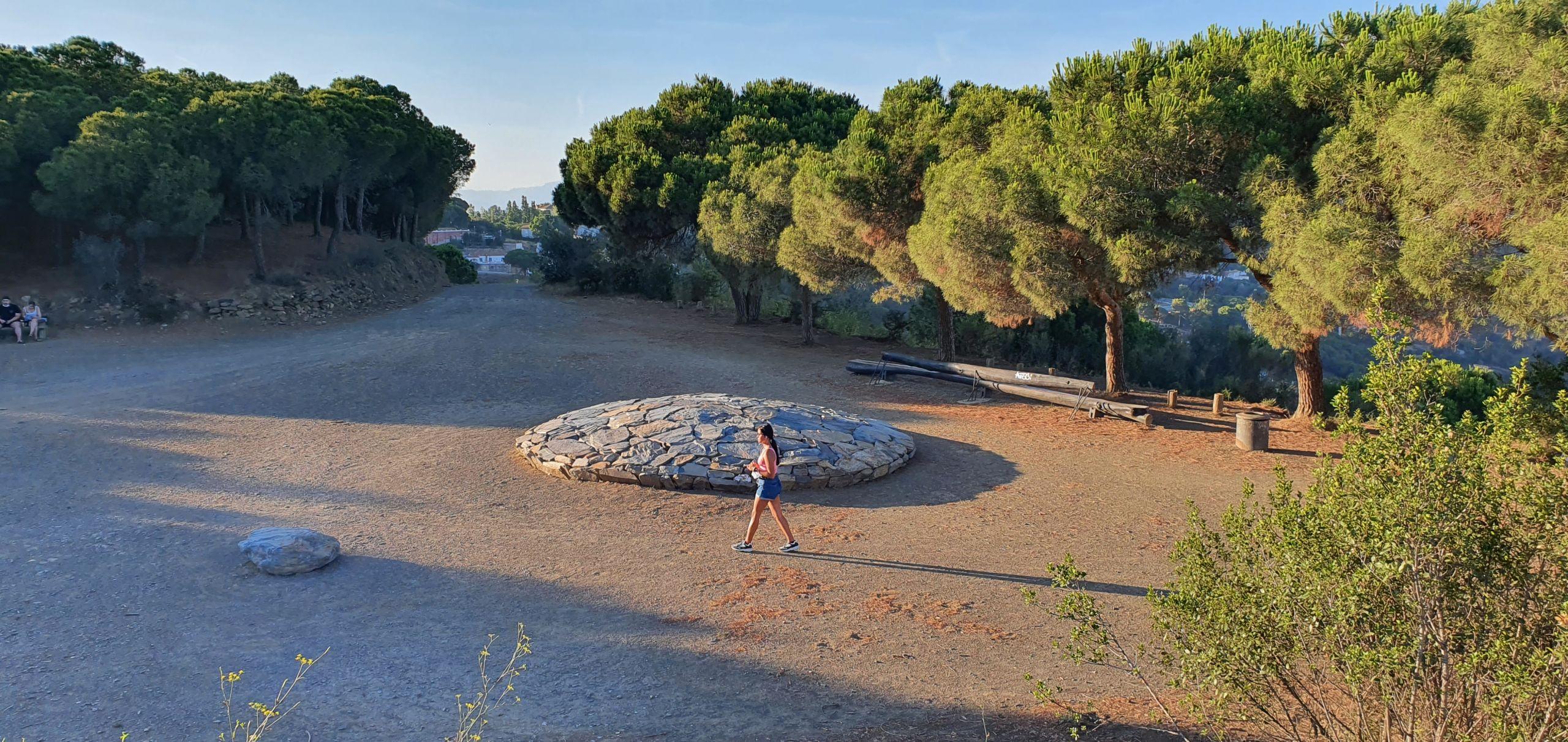
Ra in a meeting place, next to two wooden benches, aims to create a place of
rest and contemplation for people who visit the hill d'en Corts to see the
mountain, the sea and the city of Barcelona.
4. Technical
specifications
Title: Ra. Myth, space-time
Author: Víctor Mata i Ventura
Material: 14 m³ of slate stone
Technique: dry stone
Motif: conditioning and development of
the d'en Corts hill. The stones are laid by weight, leaving the upper part
smooth and homogeneous. The first row of stones begins in a small trench that
determines the shape of the structure.
Arrangement: It is adapted to the
useful surface area on the east side of the square, three or four metres from
the benches. See image 3.
Size: diameter 7 m x maximum height 0.70
m.
Location: Turó d'en Corts
(Natural Park of the Sierra de Collserola-Barcelona).
Chronology: spring 2021.