BIO
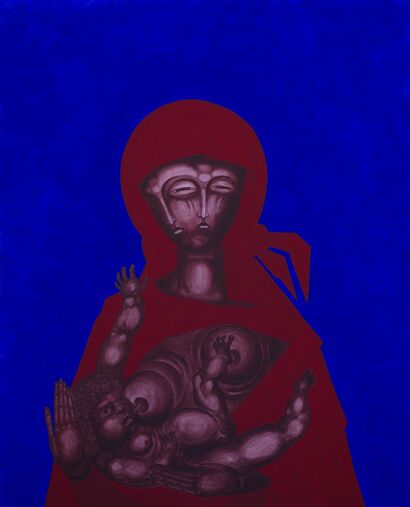
Vladimir Nosalskiy (Vova Lenin) is a self-taught multidisciplinary artist working across painting, drawing, sculpture, art photography, and spatial installations. He was born in Balashikha and lives and works in Moscow.
Since 1999, he has worked in production design. His experience in creating complex spatial solutions and large-scale objects has become an important part of his professional toolkit. In the late 2010s, photography became one of the bridges to a renewed period of active artistic practice.
Nosalskiy independently carries out the full production cycle of art objects and installations, combining different media, techniques, and materials. Vova Lenin is his established professional identity, formed over years of work in production design and used in the context of his art practice.
ARTIST STATEMENT
My artistic practice is centered on the human being — on who they are today and who they have always been — and on their material and spiritual surroundings. I am interested in the human being in relation to themselves, to other people, society as a whole, our history, the material world, and the environment they create and which, in turn, affects them.
I work across different media: painting, drawing, photography, sculpture, and spatial objects. I do not seek to develop a single recognizable style. It is more important for me to find the form, technique, and material that answer a specific artistic task. A uniform visual language should not become a formula repeated from one work to the next.
A process may begin with a word, an idea, an observation, a situation, a vague image, or the material itself. When a dialogue emerges between an idea and matter, the material does not simply realize what was conceived; it can also redirect the work and change its form and content. I am interested in its physical properties, origin, and possible associations. I prefer direct physical engagement with materials: I dismantle, clean, break, join, and alter their state and form. Material is not passive: it can resist, crack, and behave unpredictably. Traces of this interaction often remain in the finished work. Experiment, chance, and control have different roles in different works.
I am particularly drawn to the transformation of what was once mass-produced into something unique. Objects originally manufactured in series and existing among many similar examples gradually acquire their own histories and singular traces of existence. They age, change, and lose their original function. I collect their fragments and remains, combine them with other elements, and place them in a new context, turning them into unique works. This principle appears in sculpture, assemblage, and other media. Uniqueness arises not only from the singularity of the result, but from the unrepeatable combination of time, the condition of the material, and the artist’s intervention.
I am drawn to borderline states, the absurd, mythological images, and historical memory. I give them material form through the collision of textures, the deformation of forms, shifts in familiar scale, and unexpected combinations of objects that can take on an almost mythological resonance in a new context. These themes also appear through images of people, work with found objects and archival photographs, material experiments, and spatial objects.
My many years of experience in the event industry and production design have influenced my understanding of space and how I work with it. Light, scale, the movement of people, and the temporary nature of an event environment can all change the perception of an object and its interaction with the viewer. This experience has become part of my professional toolkit and enables me to independently carry out the full production cycle of art objects and spatial installations.
Although my works are connected by an interest in the human being and their world, they do not form a single system with an obligatory linear logic. Each cycle has its own theme, internal connections, and artistic language. Intersections may arise between them, but these do not cancel the autonomy of each direction.
I do not seek to reduce each work to a single plot or predetermined interpretation. It is important to me that a work can exist independently, interact directly with the viewer, and not be exhausted by the artist’s explanation.
SOLO EXHIBITIONS
•2025 — “OPUS III”, Kirill Daneliya Gallery, Moscow, Russia
•2024 — “Caprichos of LENIN”, Kirill Daneliya Gallery, Moscow, Russia
•2023 — “Panopticon of LENIN”, Kirill Daneliya Gallery, Moscow, Russia
•2022 — “Yüz Tutulması”, Gugacontemporary, Istanbul, Turkey
•2000 — “Cocoon-2000”, DEN Gallery, Moscow, Russia
•1999 — “26 Steps to…”, Photocenter on Gogolevsky Boulevard, Moscow, Russia
SELECTED GROUP EXHIBITIONS AND PROJECTS
•2026 — “To the Touch” (“На ощупь”), charity art project and auction, Jewish Museum and Tolerance Center, Moscow, Russia (collaborative work “Мир разный очень” with residents of the Yaseneva Polyana Resource Center)
•2026 — “Talking Copy 2.0”, Zayka Space, Moscow, Russia
•2025 — “Eros & Thanatos”, New Academy of Moscow, Moscow, Russia
•2025 — “Hunting for the Soluble Fish-6”, Zverev Center of Contemporary Art, Moscow, Russia
•2024 — “After the Icon”, State Museum of the History of Religion, St. Petersburg, Russia
•2024 — “Painted Hearth. Nose on Fire”, [venue to be confirmed], Moscow, Russia
•2024 — “Hunting for the Soluble Fish-5”, Zverev Center of Contemporary Art, Moscow, Russia
•2024 — “Grandchildren of Oktyabrina”, Nigde Krome Gallery, Moscow, Russia
•2023 — “Hunting for the Soluble Fish-4”, Zverev Center of Contemporary Art, Moscow, Russia
•2023 — “Exactly Lab”, Shoreditch Arts Club, London, UK
•2022 — “Anthology of the Russian Chthon”, Zverev Center of Contemporary Art, Moscow, Russia
•2021 — “Ball and Cross. Collector’s Choice”, All-Russian Museum of Decorative Arts, Moscow, Russia
•2020 — “Global Conversation 2020”, United Nations Headquarters, New York, USA
•2019 — “Arte Laguna Prize”, Venice, Italy
•2019 — “ART for EVERYONE”, PROUN_MOSCOW Gallery, Moscow, Russia
•2018 — “TRAVELS”, AAP Magazine, USA
•1999 — “Kazantip-1”, Nivinsky Gallery, Moscow, Russia