Francesca Virginia Coppola is a multidisciplinary artist who lives and works between Rome and Los Angeles. Her work begins from existence as a primary condition, engaging with matter that precedes cultural projection.She uses found elements including barks, branches, seeds, rocks,...
Read MoreFrancesca Virginia Coppola is a multidisciplinary artist who lives and works between Rome and Los Angeles. Her work begins from existence as a primary condition, engaging with matter that precedes cultural projection.
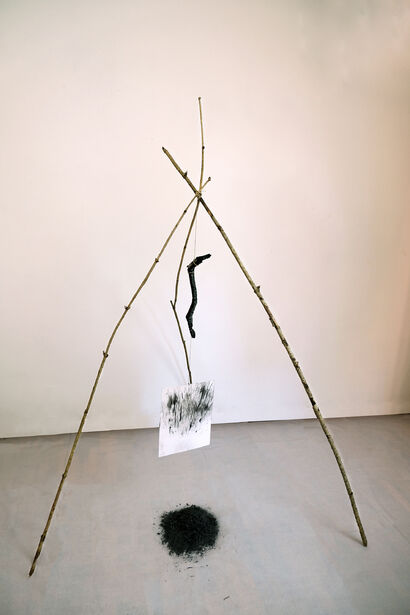
She uses found elements including barks, branches, seeds, rocks, and their extracted pigments to explore the correlation of time, human beings, organic and inorganic matter. In doing so, she embraces installation, assemblage, and soil/tree ‘rubbings’, a technique she developed to capture her situated relationship with the environment.
Site specificity is a pivotal aspect of Coppola’s practice. When conceiving her exhibitions, she engages with the surroundings of the venues. This reflects in her titles, where scientific nomenclature, time, and geographical references indicate where and when the materials are gathered. These fragments of reality are transitional objects bridging nature as a primal level of existence to the artist’s inner thinking.
In Coppola’s work, artistic intervention holds no hierarchical priority over organic or biological phenomena, both are understood as occurrences within the same field of existence. Her process-based and site-specific configurations precede narrative or imposed meaning. The work happens at the threshold of time, being and place.
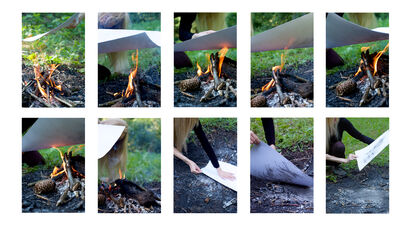
Her work has been exhibited internationally at the Silkeborg Bad Art Center (Denmark), Brand Library & Art Center (California, USA), and featured in MoMA’s In the Studio program (New York, USA). A finalist in the 19th edition of the Arte Laguna Prize (Venice, Italy), she has been awarded notable residencies, including The Wild: Artist in Residence (Ontario, Canada) and recently NAHR (Val Taleggio, Italy), where she experimented with the use of fire as a medium, deepening her investigation of ephemerality.